
I have also had armor all crack my dashboards and have had heard it happen to many people as well. Probably would do the same to a fly line, so I don't think i'm going to use it.
- Log in to post comments
I have also had armor all crack my dashboards and have had heard it happen to many people as well. Probably would do the same to a fly line, so I don't think i'm going to use it.
Made some myself. They really work well for shrimp flies and crank baits("Lures")
This is a truly remarkable pattern, economical in every way. The trailing CDC fibres are what really trigger.
My only problem with this is when I tie this in smaller sizes - 16 to 20 - esp. 16, the fly seems to want to roll over on an angle almost to its side. Any ideas?
John,
Hook sizes are what you can read: 4-8 or 6-8 depending on the make. Hook sizes are universal and basically the same all over the world.
And a bung is a strike indicator. Read about buzzer fishing here.
Martin
Nathan,
The braided line is the backing.
The rubber like line is the fly line.
The monofilament is the leader.
Martin
Laura...
Thanks... I think...
A predator mugs my fly, thinking that it's a meal, and line goes tight...
Quickly brought to hand, I have just caught my dinner but, I hasten a release and send the fish back into deep water to fight another day...
Now THAT'S IRONY!?
CIAO
Hi, thanks for the easy set-up instructions. I am, however, confused about one thing. I have a braided nylon type line, and then a smooth rubber type line, and then a tapered monofillament. Which one is which??
Hello, I wanted to thank you for all of your web site. I am somewhat new at tying and you folks are a big help. I found you while trying to find tying directions for a george grant fly called golden stonefly nymph or black and tan featherback. It was pictured on p. 32 of the spring 2010 Fly Tyer. Last year I put together my own version of a glass bead scud and a local fly shop bought 20. A customer bought one and caught a fish and came back and bought my other 19 flies. Thanks again for the site and all the work..
What is the hook size in American-ese? What is a bung? Thanks.
A great help. Thanks for your assistance. Good simple instructions using affordable methods.
I wish I knew this when I visited Belgium at least once a year...
A caution about Armor-All. I have found that, while it's designed for use on vinyls and other plastics, it can degrade them down over time with UV exposure. I have a couple of Porsche dash replacements to confirm my suspicions, and a Brother who, being an engineer who specialized in plastics manufacture, doesn't like Armor-All on plastics long-term either. I know it's made for them, but it seems to actually dry out interior parts in the sun. Perhaps just my experience, but it is my experience, nonetheless. I've had really good luck with 303 Protectant, though I have never used it on fly lines. Vinylex is also really good for car plastics.
All that said, I'm enclined to echo the sentiment to use products designed for the lines. They may be precisely the same formulation as something like 303, but they are relatively cheap and I don't use them every day, so they last a while. Now, if I find that, say, SA cleaner is really the same chemical cocktail as my gallon of 303, the choice is easier. And I will be sure to let everyone know!
Great video! Thanks for the instruction, this is one of my favorites for Trout fishing here in New Brunswick.
Dear Mr. Boyd
I started building bamboo about 10 years ago. I took some instruction from Darrel Whitehead and Mr.Bellinger in oregon. Things were going very well until three years ago when my partner and son became ill and passed away.I would like to build a clientail of buyers that would like to buy great quailty bamboo rod blanks as my son done most of the detailed wraps that I can no longer do to perfection due to my eyes. Do you have any sugestions that might help me? Thanks Bernie Stark
I appologize if I am out of line asking you thru your web site.
Brilliant !!!!!!!!! I've always wondered why more people don't use squid patterns for Pacific salmon in the salt. I've had good luck with squid patterns on Silvers off the Homer Spit in Alaska but seem to be in a minority of one when it comes to squid in Alaska.
once again the phlymaster crafts another phishcatcher!!!
the phortyinchers don't stand a chance.....,Great job, Sir Penquin.
Da Rooster!
That is a very interesting ANT. I think they will do nicely in my lake box... 😄
PT/TB
Glen,
It's not that complicated. The setup shown in the picture is just an example of how to use three lamps. One can do it, two is a bit better. These days you can use normal lamps with normal bulbs because the digital camera can compensate for the warm light.
The most important part of lighting is getting soft light! Put some cloth, thin paper, translucent plastic or glass felt (like used for wallpaper) between your light source and your fly. Careful with the heat if you use halogen lamps! You can also use a large lamp with a big reflector or one of these office lamps that use a tube rather than a bulb. By getting a large and soft light source, you get even and nice light on your flies with no harsh shadows.
Regarding camera, all you need is to make sure that the macro function is good. I recently bought a Canon Ixus 95 (Also known as Canon PowerShot SD1200) for my mother, and that is an excellent, inexpensive camera, which does macro nicely. My guess is that you should be able to find this particular model at USD 150.- or less.
The background is cardboard, which I buy at places such as Michael's Craft. They have a ton of colors and it's less than a dollar per sheet. I simply hang it using a couple of clothespins or tape or I lean up against a box placed on the table behind my fly. At an adequate distance it will render nice and out of focus. You can experiment with that.
Don't make this rocket science! Get a camera and start shooting.
Martin
I am an old guy trying to understand this all. This picture is what I thought would be the best set up, I want to take pictures of my own flies and have it in my computer. I do not understand the back ground thing though and would like to know how to get it, plus just a camera, good price, to take the picture. Do you have to have all those lamps that provide light. What bulbs are in those lamps or lamp that works best? Basically just a good picture is all I need so exactly what camera is avialable today, that would work. Now realize you are talking to a guy in Veterans Home, Brain damage, I need alot of details because of this and I would appreciate it alot, its one of my dreams to be able to do this and eventually sell flys. Thanks, appreciate this site, still don't quite get it all though.
Glen
Big Horns fisherman
old Riverrunner
Greetings Martin, What can I say after such a comprehensive reply!? There are equipment collectors - and obviously - there are eqipment destroyers!
Interesting that none of the dry and wait tehniques have ever worked for me - fresh or salt water. I don't have the camea corpses to display as the insurance company claimed them - probably as proof of the claim. Loved the link to your site - have bookmarked it for future visits!
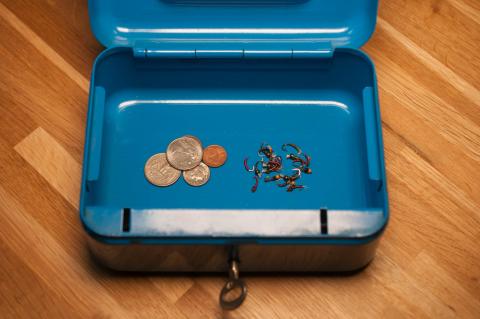
-very nice box very, nice arrangment it looks like a pattern we use in montana only chenille instead of krystal dub and it works all year long even under the ice.But i might have to try it this way
Wolfie,
Oh I have drowned cameras! My list is almost as long as yours (4 PowerShots), and I even documented it and wrote a bit about it:
This one is definitely under! Notice the shrimp!
Post mortem reconstruction...
And more here: How to drown a Canon PowerShot
And speaking of shutter buttons... that reminds me of my old Minolta 7000i film camera, which had this shutter issue... due to contact with salt water it was fairly unwilling to expose pictures (not great for a camera) and for a long time I had to pouch my lips around the shutter and blow moist breath into the button mechanics to get it to come alive and be able to fire.
I routinely did that for a year or so until a friend lent me some contact cleaner on a spray can, which cleaned out the oxidization that must have formed on the contact. It worked like a clockwork since then - and still does.
So it does cost to bring cameras near the water. But on the other hand it also gives you hundreds of great pictures.
Martin
Thanks Pete, for sharing, also from Italy.
A sense of irony is, in my opinion, guarantee of freedom... and, to my eyes, some of your 'freestyle' tying are full of sense of irony!
Laura
… I have a small favor to ask.
Support the Global FlyFisher through several different channels, including PayPal.
The Global FlyFisher has been online since the mid-90's and has been free to access for everybody since day one – and will stay free for as long as I run it.
But that doesn't mean that it's free to run.
It costs money to drive a large site like this.
See more details about what you can do to help in this blog post.