



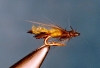







Beginner's Buzzer
A Buzzer is basically an imitation of the pupa of a midge. The buzzers are best known from British stillwater fishing, but are actually very widespread and common all over the world. Learn how to tie a simple buzzer and how to fish it.

Orange Beginner's Buzzer
|

One fell for the Buzzer
|
A Buzzer is basically an imitation of the pupa of a midge or chironomid - in other words a non-biting "mosquito" in the state between a larva and the adult, flying insect.
Most people will already know midges in two forms: the red blood worm found in many lake sediments, which are the midge larvae, and the big swarms of "dancing" midges, which are the insects mating in mid-air in large numbers.
The midges are interesting to imitate for several reasons:
- They are very abundant, particularly in stillwaters with hundreds of species present in both Europe and the US
- They hatch almost year round
- They are high on the menu for stillwater trout
Because of this, buzzers are particularly interesting when fishing stillwaters, and most of the fishing methods developed for these patterns are specifically aimed at lake and pond fishing.
The sparsest of patterns
One thing that characterizes the buzzer patterns is their sparseness.
The skinny patterns are motivated by several factors. The animals that they imitate are small and slender, and there is often a wish for a fly that moves and sinks freely in the water. Lack of body volume is one way of obtaining this.
This incarnation of the buzzer is a fairly simple version using easily available materials. This pattern also avoids using epoxy or other resins, which is common in many modern buzzer patterns. I found that this buzzer was a good entry point to the world of buzzers - one of the reasons for the name Beginner's Buzzer.
The pattern is very generic, and has not been developed by me. My inspiration stems from flies tied by my good friend the Welsh fly tyer and angler Paul Slaney, but I'm almost positive that he wouldn't want to take credit for the fly either.
Larger than life
Even though midges may be likened to mosquitoes in many ways, their pupae are significantly larger than mosquito pupae. The average length is 8-15mm (1/4-1/2 inch) and the buzzers are therefore tied in rather large sizes. The typical fly size will be 12-14, but larger flies in the 10-8 range are seen too.
But it is not only the imitative powers of the fly that has brought about its success. The fact that some anglers use a plain red, undressed hook as an imitation can underline that fact. No, the concept of buzzers is just as much the way of fishing them as it is the character of the patterns themselves.

Line arcing
|
Dead drift
The primary way of fishing buzzers is by dead drifting. Since we are fishing in still water there is little water movement to help the fly. If the fly is retrieved, it is often done slowly, mainly with a figure-of-eight-retrieve.
Many buzzer fishing methods will hang the fly just below the surface, and movements in the line will make it rise slightly towards the surface as if the pupa was about to ascend and hatch. Flies are also fished sinking as shown below.
Since the flies in the Beginner's Buzzer style will commonly be fished on a floating line, the wind will have a significant influence on the movement of the fly. The wind is actually used very deliberately in some buzzer fishing methods as described in this article about the Diawl Bach and fishing flies in teams..
Many methods
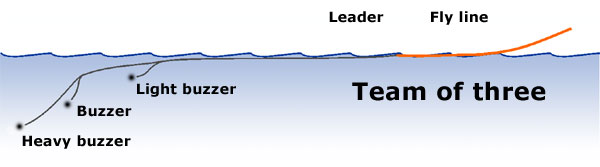
British stillwater fishing has long traditions, and over the years a wealth of methods have been developed. A common way of fishing buzzers is in a team of two, three or even four flies. The mainstay buzzer setup these days is a team of three buzzers with varying characteristics, particularly regarding sink rate:
- a top fly or top dropper - a light buzzer, typically a fluffy one or one tied on a light hook
- a dropper - a buzzer such as the Beginner's Buzzer
- a point fly - typically a heavy buzzer, epoxied to sink fast or tied on a heavy hook
Roughly said you want to fish varying depths. The point fly acts as an anchor pulling and holding the rig down. The other flies will fish above that.
Another well known way of rigging a team is a washline, where the point fly floats and the two droppers fish. The dropper can both be buzzers or a buzzer and a nymph.
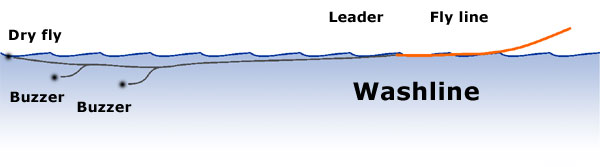
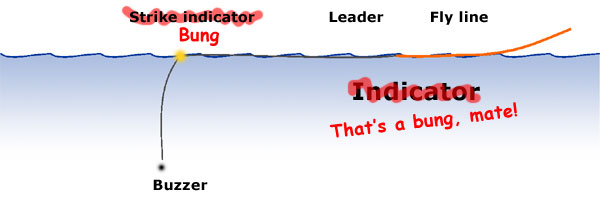
In Wales it's called a bung, but a strike indicator is probably easier to understand for the rest of us. Fish the buzzer like you would any nymph under an indicator or a large dry fly. The method is very good in calm conditions. Experiment with depths until you start getting strikes.
The last method is rather special utilizing a greased leader. Grease up a very long, level leader - about 25 feet or 6 metres. Tie on a heavy buzzer and cast it out as best you can. Keep your eyes glued to the small dimple that forms where the leader is drawn through the surface as the fly sinks. Strike the instant you see it dip.
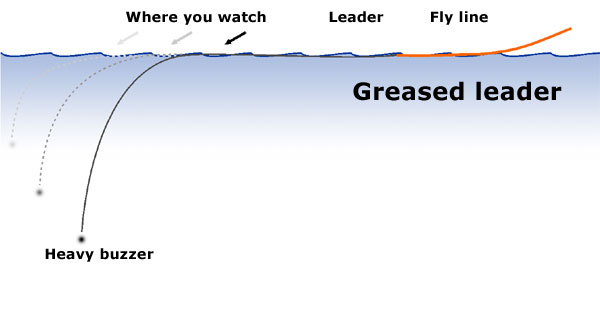
More on how to tie the leaders and how to fish a multi fly rigs like this in the article about the Diawl Bach.
The reason for the name of this fly is not as much that it aims at beginning stillwater angler or fly tyer, as it is based on the fact that I am still a novice on these patterns and the fishing methods.
Can you say sparse?
During a stay with Paul in his house in Wales we started extrapolating the idea of sparsely dressed buzzers, and honestly did go crazy a wee bit. After having tied a bunch of average buzzers along the lines shown in the pattern description below, we started tying thinner and thinner flies, in the end winding up with something very close to a bare hook. It might seem like useless experimenting, but these flies could easily find their day in a buzzer fisherman's life.
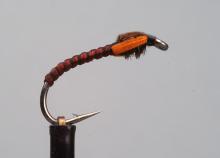
Beginner's Buzzer
|

Bare shank Beginner's Buzzer
|

Mylar shank Beginner's Buzzer - quite skinny
|

Ridicously sparsely dressed Beginner's Buzzer
|

Tying steps

Curved nymph hook, size 8-12
|

Attach ribbing
|

Create body
|

Wind ribbing
|

Tie down and trim
|

Attach shield
|
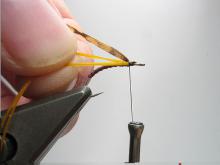
Attach sides
|

Attach herl
|

Run herl forwards
|

Draw sides forwards and tie down
|
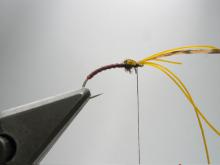
Draw wing case forwards and tie down
|
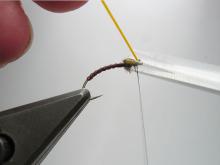
Trim all excess material
|

Finished buzzer
|
Read more about why you should register.
Related content


More content from the front page







Since you got this far …
The GFF money box
… I have a small favor to ask.
Long story short
Support the Global FlyFisher through several different channels, including PayPal.
Long story longer
The Global FlyFisher has been online since the mid-90's and has been free to access for everybody since day one – and will stay free for as long as I run it.
But that doesn't mean that it's free to run.
It costs money to drive a large site like this.
See more details about what you can do to help in this blog post.

Comments
Rick, My guess is
Rick,
My guess is that buzzer fishing would work in your streams too. I'd think that slower parts of the streams with softer bottom would be good candidates for buzzer fishing - parts that could be home to midges and mosquitoes and their larvae, which is what buzzers are imitating.
I usually use a loop knot for small flies like buzzers to enable the fly to move freely. My personal favorite loop knot is the surgeons loop, but other loops work just as fine.
Martin
Hi Martin, Always e
Hi Martin,
Always enjoy your articles ! I live in the US and fish small streams for trout. Would buzzer fishing be applicable to this type of trout fishing? Also, what type of knot are you using on your beginners buzzer and do you use this knot with most flies that you fish? I know it is to allow more natural movement to the fly..
Thanks Very Much for your articles
Great help and comme
Great help and comments on Buzzer fishing. I found that if you tie the Shuttlecock type buzzers against the bend in the hook as opposed to with the bend- as we normally tie on flies and buzzers- then it helps to suspend them the right way up in the surface film. They seem to hang naturally there. This might help someone.
Chris, As much as
Chris,
As much as some people might like to see video of everything, there's a limit to the time we can spend producing stuff for the site - and I honestly think the images do a fine job and take a fraction of the time to produce.
Martin
the diagrams are han
the diagrams are handy but there are videos on youtube etc, which make tying flies for beginners alot easier. the details on how to fish the buzzers was extremely helpful tho. cheers :):)
Hi Martin, informati
Hi Martin, information on tying buzzers is brill,been tying flies and lures for about 2yrs, good one about the onion bags and orange bags will be using this method as part of my tying kit. Also i would like say on a vist to my mother laws she was throwing out a sewing box, of course i took it home with me,my goodness the amountof stuff in there,elastic that she would of sewin into wasitbands, strip in down and u have the perfect vibrator legs. Thanks,
Patrick, Of cours
Patrick,
Of course you can use red floss in stead! No problem. No fly pattern is set in stone, and you can always improvise. I have used yellow and tan as well, but just like the orange color.
Martin
hi, i am
hi,
i am 15 years old and have been fishing since i was 6 and has been tying since i was 14. Would it be that much of a bad influence if i used red floss instead?
Chris, You ask...
Chris,
You ask... which your have already done. And we grant permission according to our general rules: non-commercial endeavors - like club newsletters - are granted a carte blanche permission to copy articles as long as they are properly credited.
Martin
I would like to dupl
I would like to duplicate this article in my fly fishing club newsletter with the proper reference to authors,artist,photographer, and etc.
How do I obtain permission to do so?
Just starting fly fi
Just starting fly fishing and I would like to say I will use your site to learn how to tie my own fly may be some time you will put small vidio clips on to help fly tying thanks
There is no need to
There is no need to spend money on special materials. In UK supermarkets we buy onions and oranges in plastic net bags. Pull them apart. The thin orange and red strips of plastic netting provide the perfect ribbing and bound heads, especially if overlaid with thin silver wire and then superglued. Believe me this is a killer pattern all year round. Just wrap round to finish and make a full plastic head. No need for cheeks. the trout are not that smart!
Stuart C
the diagrams are a b
the diagrams are a brillant idea as well as the discripsions,as a new starter there is so much advise out there the simplere the better,thanks Steve
Well just starting f
Well just starting fly fishing and tying, am going to give this a go as looks easy ( cough cough ) May i also say what a wicked site :)
Cheers
Steve
Ed, The elastic f
Ed,
The elastic floss is nothing but thin, smooth rubber band on spools. I don't know the brand name, but I think Uni has something called UNI-Stretch, which is the same.
You could also varnish or epoxy the floss. That gives a great effect and makes your fly close to indestructible.
Martin
The buzzer looks gre
The buzzer looks great and fished great even when I tied it with regular floss, which dosen't stand more than a couple of bites before getting loose ans ruining the fly. So, what is "elastic floss"? Where can I buy it online?
Thanks,
Ed
I was very impressed
I was very impressed with the detail on the buzzer fly it was not only the tying but the clear way on how to fish it.All i have to do, is try this out in pratice thank you very much .I shall report back.
I tied up a few of t
I tied up a few of these flys and it was non-stop action in the great Canadian North where I'm from. you wouldn't have any more patterns like these would you ?
Thanks
Use of your articles
Hi I am the secretary of a small angling club in Scotland and I would like to have your permission to copy some of your articles on to our FB page to help our juniors and members?
I would gladly mention where the article has came from
Thank you
Gary
Don't copy, link
Gary,
We prefer not to see copies of our articles to other places on the web - web sites, Facebook, blogs or other sites. For translation to other languages it's OK, but a 1:1 copy makes no sense.
You are welcome to link to our articles from Facebook or any other place, and also reproduce them in club newsletters or magazines as long as they are non-commercial. But please don't copy text and images for web use.
Martin