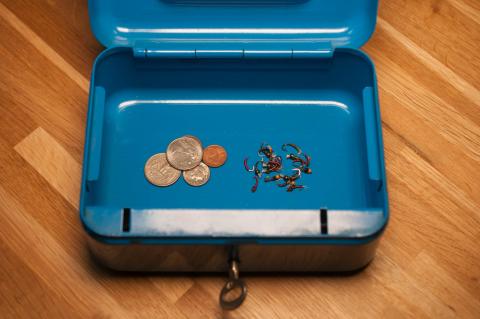
I've lost more than one nice smallmouth bass because the hook went dull banging off the rocks. I carry a diamond sharpener and touch up any fly that won't bite into my thumbnail.
- Log in to post comments
I've lost more than one nice smallmouth bass because the hook went dull banging off the rocks. I carry a diamond sharpener and touch up any fly that won't bite into my thumbnail.
Lovely fly there Bob. :-)
Nice tye Bob,neat head...
great number, great quality ! keep it up !
Best wishes from Romania!
Congratulations Martin! GFF is the most democratic cyberspace of fly fishing. Great vídeos, nice photos and a space for politics discussions on fly fishing. Politic in the sense of relations between fisherman, market, economy an enviroment.
Cheers. Ernesto Guevara
Benbow,
The guardian that would be me, and I'm simply keeping people and machines from adding spam links to fake comments, which immediately happens as soon as it's allowed. Been there and done that. But send me the link, and I'll be pleased to add it to your comment.
Even with the ban we still get tons of spam. After having replied to this I deleted four irrelevant comments about odd pills and one about inflatable boats. They could easily have been 20 or 30 if direct links were allowed.
Martin
I just found a site that lists flytying hook sizes in millimeters. Unfortunately, the guardians of this website do not allow posting URL's, and for security reasons I accept that. They don't seem to allow cut-and-paste of the chart either. Go to SwittersB&Flyfishing and you should find the chart as I did.
And yes, of all the commercial fly retailers L.L. Beans Hornberg is the best ive seen too. It has some kind of aura the others dont lol, sounds like crap I know but I swear by it.
Interesting thread. We raise chickens, and I must agree with the cone/bag method for slaughter. It is quick and low-stress for the bird.
But many will discover that raising chickens only for the feathers is NOT worth it, economically. It's cheaper to buy them. Heck, it's more expensive, even when you use the meat and eggs, like we do. But it's worth it, if you are trying to stay hormone, pesticide and antibiotic-free in what you eat.
So is it possible to learn which boat was the "relable" for the big box stores?
This Brian guy knows what's up. Coming from a ski mountaineering background if you want to stay the warmest in cold conditions evaporation is your enemy not wetness. See the hardy alaskans that use vbl in their shoes, vests for backsweat from packs and sleeping bags when climbing big AK peaks. It is kind of an odd feeling having vbl on but as long as you have dry clothes to change into after you're done fishing the extra insulation from the neoprene will keep you warmer
I am also looking for a chart that includes the actual gap dimensions in millimeters as well as a true-size depiction of flytying hooks. I looked up Netcraft, but their chart only goes down to size 16, and I tie down to size 22. They do not include millimeter sizes for flytying hooks. In the meantime, what I do to sort hooks that have gotten mixed up is this: I lay out on a sheet of white stock paper hooks of known size at the top of each of three columns: 14, 16 and 18 in my case. I then spread out the mixed hooks and move each to the column that best appears to match. Any that then seem out of place then get moved one direction or the other. Hooks too small for even 18 become designated 20 until they, too, seem divided. The smaller ones there are thus 22's, the smallest hook I use. Conversely, those larger than the hooks in the #14 column become 12's, the largest I use other than streamer hooks. In the absence of a functional chart, this works for me. BTW: I think the best containers for flytying hooks are the prescription bottles from Walgreens. They even give me empty ones without charge [though I am a regular customer]. The tops screw on, so there's little chance of spillage, and the reversible caps can act as holders for a half-dozen or so hooks while tying. I use Avery labels to identify what's in the bottle.
Thanks folks...>Looks like the head cement oxidied on that one, and on the brown julie, come to think of it.
I like this pattern are you great idea, I will try this version.
just found this site and found it to be a very interesting fly tying site !!!!!
Long way from South Portland but love the county - daughter Deb Dunn used to live in Presque Isle and was my excuse to travel there.
Tom, this one is definitely a winner. I love the colors, and all it stands for. You stepped up to meet the challenge here, no doubt about it!
Eunan,
Really nice tye of Gray Wolf's pattern. This pattern is a real fish catcher in Western Canada. Everyone should try this pattern.
.
Beautiful concept. Ive been toying with these and other glass beads, having made several soft hackle, Yorkshire-style spiders with bead bodies. This dovetails nicely from that.
I only hope these work on my SE USA bluegill - I suspect they will.
Another winner- thanks Martin J. for making it possible. I have bunches of these beads, and they are common as dirt. I'd like to add they are usually seen where I buy them as 6/0 size or sometime "E."
I've experimenting with ways to use them, as well as working out a good nymph pattern for next season - now I know what I'll do.
Thank you, sir!
Wonderful article-I'm brand new to making a fly of any kind. I purchase commercial tied jigs primarily for fishing
Coho Salmon in the Northwest, Chehalis river system. The Bloody Zonker has the color & heavier body Coho like.
I will be casting 0ne quarter oz. round ball jigs. This pattern will be tied on 1/ 0 2/0 jig hooks, the water is typically stained and fast moving. I may improvise a little because of the hook size.
Anyway - thanks again for a great tutorial on the tying of this fly. Will let you know how it works. Al Bahr
Gary Soucie' book Wooly Wisdom actually has this pattern ive tied and fished it here in Maine and done fairly well on local waters, definitely not the killer here in the states that it is in Scandanavia.
… I have a small favor to ask.
Support the Global FlyFisher through several different channels, including PayPal.
The Global FlyFisher has been online since the mid-90's and has been free to access for everybody since day one – and will stay free for as long as I run it.
But that doesn't mean that it's free to run.
It costs money to drive a large site like this.
See more details about what you can do to help in this blog post.