Recent comments

Submitted by Steve S. on

Permalink

Great article my being a newbie to this stuff and also a late bloomer it's good to get insight on how to use a lot of things. I've recently done business with a guy in Montana website flytyersdungeon.com and he has a lot of synthetic stuff dyes and blends his own fresh or salt really easy to do business with--A big THANKS to his site I'm fortunate to live on a great smallmouth stream in the ozarks.

Submitted by George Meyer on

Permalink

Deadly, enough said, have had the joy of catching 12 species of fish on BRBs, never fails to get itvdone great sesrching cold water
pattern here in Maine, Rapid Rivers legendary brookies love the olive, black, natural deer hair version.Ive personally landed multiple 5 and 6 lb fish with this fly.

Submitted by petegray on

Permalink

G'day Martin
I go to school every time I read your articles Great stuff, enlightening content, and always a wonderful resource 'Keepupthegoodwork!!!
Cheeerz
Pete on the phrozen windswept shores of Kape Kodistan

Submitted by 1737246311 on

Permalink

Hello Martin,

Very good article and a load of very nice photo's and illustrations.

Best regards,

Tom Biesot.

Submitted by Tony Stewart 1… on

Permalink

Congratulations, a great achievement. Thoroughly enjoy visiting the site every week for the entertainment and lessons learnt from some expert filmmaker/flyfisherman. Thanks for providing such a comprehensive medium.
Keep up the excellent work. inthebubbleline media

Submitted by John Snow on

Permalink

This has to be the simplest yet best looking shrimp imitation out there. Should be a Trout and Redfish killer here in N.E. Florida. So easy and efficient to tie. Thanks for sharing your recipe and also thanks to Global for publishing. This is the best fly tying site!

Submitted by Ed Null on

Permalink

Cool idea about the coffee seal! I'll remember that one, and have the wife save the next one.

Submitted by Ed Null on

Permalink

Nice, Martin. Big flies for big fish. I'm a natural material guy, but I will investigate some of the lighter synthetics. Getting harder for the old goat to swing a big rod all day. ;-)

Submitted by Clint Brumitt … on

Permalink

I began a few years ago to tie small soft hackles in the 16 to 20 size range. Feathers are few and far between on the partridge skins to reach that size hook.
I stumbled on to a video on You Tube, I believe from the Blue Ribbon Fly Shop that showed how to use any size
soft hackle feather and create a soft hackle for the fly. In essence, the trick is to cut the stem and form a V in the feather. Using that notch in the feather, spin the available feather herl like you would deer hair in a single action that creates the soft hackle wrap.
Very educational and very easy to do. Matched with your content on how to use and select feathers, anyone could tie any size soft hackle.

Submitted by Clint Brumitt … on

Permalink

One additional item that can be used to make eyes...
The flavor seal on what used to be three pound coffee container are a bright silver color.
Cut or punched, they can be used with the system as explained in this article.

Submitted by John on

Permalink

I am looking for a Pamola fly tying vise. If anyone has one for sale or knows of one that might be for sale please let me know.
Thanks, John

Submitted by Phil Ewanicki on

Permalink

Levered cam fly vises, especially those with narrow jaws, put an amazing amount of pressure on the hook wire. I have heard this pressure can weaken the steel in the hook wire. I believe it; the broken hooks I have found myself fishing with broke right where the vise jaws were on the hook bend. To prevent this I use a technique suggested by Art Flick: Cut a small piece of light cardboard/paper (like a cereal box), bend it in half, and place the hook bend between the halves. Trim the cardboard so it won't protrude far beyond the vise jaws, place the paper-wrapped bend of the hook in the vise and close the jaws with about half the pressure you normally use. The hook will be held rock-solid in the jaws of even the cheapest vise and the chances of the hook breaking are greatly reduced.

Congratulations Martin and GFF on the videos. You have a wonderful site filled with entertainment and great information. It is a place where everyone can learn something. No mater what your level of fly tying ability is, you can't know it all. I learn something new everytime I come to this site.

Thank you for making this site available. There is nothing like it. Keep up the good work. I look forward to seeing you the next time you come to the Catskill Mountains.

One thing not mentioned is the hook quality. Cheap hooks have points that break off. Also a cheap hook has inferior wire and doesn't have high carbon wire. Cheap hooks aren't a bargain if the points break off. I can't recall the last time I broke a point off, I don't fish saltwater though. If you sharpen points, that will often remove the coating, causing them to rust. Black Nickel hooks are usually the sharpest and some of the worst are blackened salmon hooks, those usually almost always have dull points because they are painted.

Bending hooks removes a hook's tempering. When the heat treating fails, the hook usually breaks. Cheaper hooks are almost always not heat treated well because that involves another step which costs time and money.

I've dropped fly boxes in the water and usually at the end of fishing for the day, I remove the flies. wrap them in a towel and bake them in the oven at 250 degrees for 30 minutes. You need a cotton towel or paper towel with no plastic fibers.

Submitted by Cap Mel Simpson on

Permalink

I've been watching him tie for sometime now and he is really a good tier. His techniques are very good...and that fly is beautiful. I'll probably steal some of his ideas!

Since you got this far …

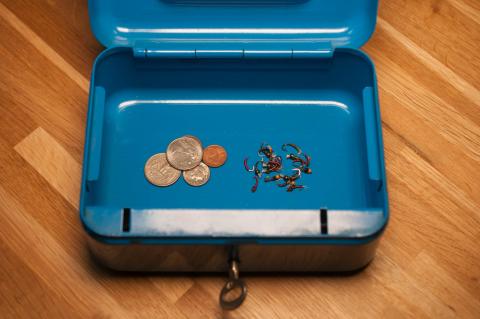
A money box
The GFF money box

… I have a small favor to ask.

Long story short

Support the Global FlyFisher through several different channels, including PayPal.

Long story longer

The Global FlyFisher has been online since the mid-90's and has been free to access for everybody since day one – and will stay free for as long as I run it.
But that doesn't mean that it's free to run.
It costs money to drive a large site like this.
See more details about what you can do to help in this blog post.