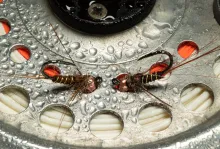
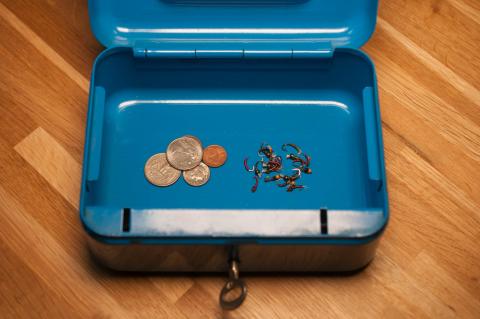
I use coloured elastic bead cord in a number of patterns, either as a rib over a dubbed body or on its own wound or knotted onto a hook as in my Genoese nymphs (Knotting Nymphs). While searching on Amazon to buy a couple of new spools I came across a material I hadn’t seen before; rubber cord tubing which is also used for stringing beads to make bracelets or necklaces. The tubing has a 2mm outer diameter with a 1.2mm inner diameter and thinking it might be useful, I added it to my order.
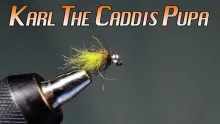
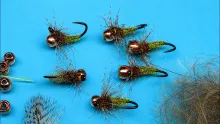
The rubber cord is translucent rather than transparent like bead cord and it’s also less stretchy, but being a tube, it flattens when wound onto a hook. A bit of experimentation with winding under different tensions produced an acceptable segmented translucent body. The effect is rather like winding nymph skin but with a fatter body and more pronounced segments. Pretty much what you’d want in a caddis pupa imitation in fact.
I tied two versions of pupae to represent different stages of the hatching process. The Shallow Pupa is unweighted with a bushy thorax to represent a hatching caddis while the Deep Pupa with a tungsten bead and small wing buds imitates an earlier stage in transition from larva to pupa.
Bead cord and bead tube
Nick Thomas
Shallow Bead Tube Pupa
Nick Thomas
Shallow Bead Tube Pupa
Fly pattern, materials and tying steps
Nick Thomas
Pupa
Materials
Hook
Hends BL554 #8/10
Bead
Iridescent glass seed bead
Thread
12/0 olive brown
Abdomen
Green bead tube
Thorax
Get Slotted hare and squirrel dubbing
Hackles
CDC and partridge
Run on the thread behind the bead and take around the bend in touching turns.
Taper the end of a piece of tube at a shallow angle, tie in and bind down up the hook.
Wind the tube forward in overlapping turns, tie in and remove the waste end.
Dub the thorax.
Tie in a partridge and a CDC feather by their tips and wind a couple of turns while stroking the fibres back.
Add a little more dubbing against the bead, smear the thread with varnish and whip finish.
Easy
Deep Pupa.
Nick Thomas
Deep Bead Tube Pupa
Nick Thomas
Deep Bead Tube Pupa
Fly pattern, materials and tying steps
Nick Thomas
Pupa
Materials
Hook
Hends BL554 #8/10
Bead
Get Slotted 3mm olive tungsten
Thread
12/0 olive brown
Abdomen
Green bead tube
Thorax
Get Slotted hare and squirrel dubbing
Wing buds
Olive organza ribbon
Run on the thread behind the bead and take around the bend in touching turns.
Taper the end of a piece of tube at a shallow angle, tie in and bind down up the hook.
Wind the tube forward in overlapping turns, tie in and remove the waste end.
Dub the thorax.
Cut a narrow strip from the edge of a piece of organza, strip out the long fibres and cut the piece in half.
Tie in the two sections on either side of the thorax with the fibres pointing up.
Bend the sections around and tie in forming loops with the fibres on the inside.
Add a little more dubbing against the bead, smear the thread with varnish and whip finish.
Easy
Body and head
Nick Thomas
Having use the bead tube to tie two stages of pupa development it occurred to me that maybe I could go back a life stage and tie and tie a cased caddis larvae. The green tube would obviously imitate the larval body, but how to give it a dark head?
I’ve used a glass bead on previous patterns, but I would need to fix it on the end of the tube. It turned out to be simple. If you heat the end of the tubing with a flame it will char and retract slightly which forms a dark flared end into which a glass bead can be pulled on a loop of copper wire.
Tube Cased Caddis
Nick Thomas
Bead Tube Cased Caddis
Nick Thomas
Bead Tube Cased Caddis
Fly pattern, materials and tying steps
Nick Thomas
Nymph
Materials
Hook
Fasna F-900 #10/12
Bead
Get Slotted 3.3mm jig-off tungsten
Thread
12/0 olive brown
Body
Green bead tube and black glass bead
Legs
Partridge
Case
Semperfli caddis brown dirty bug yarn
Thread a small glass embroidery bead onto a length of black wire, fold and twist the wire to fix the bead at the end.
Cut a piece of bead tube to the length of the hook shank and heat the end near a flame.
Push the twisted wire through the tube and pull the bead up to the melted end.
Run on the tying thread behind the tungsten bead and add turns to lock the bead in place.
Tie in the bead cord on top of the hook with the glass head hanging over the bend.
Tie down along the hook with tight wraps to compress the tube.
Tie in the wire ends behind the tungsten bead and twist to break off the wires.
Catch in s length of yarn at the bend and tie down up the shank.
Wind the yarn forward, tie in behind the bead and remove the waste end.
Pull some fibres out of the waste piece and use them to dub behind the bead.
The Global FlyFisher has been online since the mid-90's and has been free to access for everybody since day one – and will stay free for as long as I run it.
But that doesn't mean that it's free to run.
It costs money to drive a large site like this. See more details about what you can do to help in this blog post.