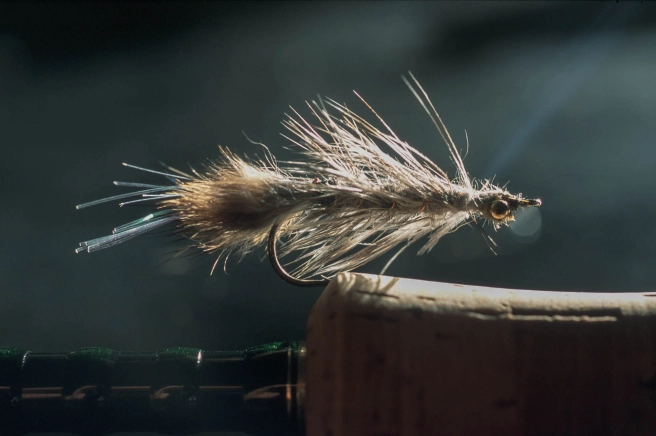
As a fly angler, there is great satisfaction in being able to tie your own flies. If you haven’t reached that point yet, here is some advice to help you get started.
It has been translated and adapted to GFF, and will hopefully serve as a good starting point for people who want to venture into fly-tying for the first time.
A lot of fly anglers also tie flies. Not everyone, but for many, fly tying is an integral part of fly fishing.
If you are a new or experienced fly angler who doesn’t yet tie flies, and you’re considering getting started, here are some tips to help you get off to a good start.
What it takes
Fly tying – like many other crafts – consists of a few essential components:
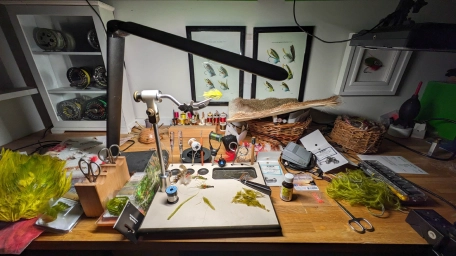
- Tools
- Materials
- Recipes and instructions
- Skills
1 and 2 can be purchased, but as with so many other things, that alone is not enough to become a good fly tier. Pots, pans, and the best knives combined with excellent ingredients will not necessarily result in a great meal – and likewise, having the best tools and materials alone does not make you a good fly tier.
That’s why – contrary to many others – I do NOT recommend that you go out and spend money on 1 and 2 as your first step.
Item 3 is easy to access. In fly tying we call the recipes patterns, and you’ll find thousands of these patterns and accompanying instructions in books, magazines, and online. And there are just as many videos available, giving you direct and free access to visual instruction.
Item 4 is where things get trickier. To stick with the cooking analogy: you don’t become a great chef by reading cookbooks or watching cooking videos online. It can certainly help, and some books and videos are excellent for getting started. Skills come from training and routine as you can read in the article Don’t buy supplies ... tie flies!.
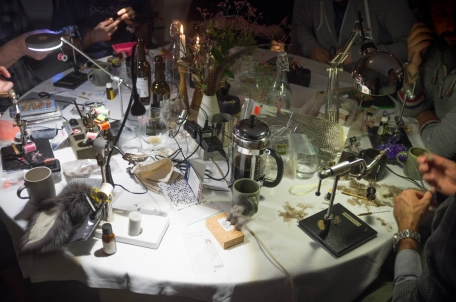
But I think you should do a fifth thing before you go too far:
- Get instruction!
Before you do anything on your own, tie flies together with someone who knows how – and preferably someone who is both good at tying flies and knows how to teach.
Fly tying with others
Finding someone to tie with should be easy, but maybe the options aren’t good where you live.
You can give the internet a try. A search for “fly tying course” and your town or region shows that many tackle shops and clubs regularly host courses. There, you may gain access to instruction, either free of charge or for a – typically reasonable – fee.
Often, especially in beginner courses, you can borrow tying tools and buy the necessary materials (or they may be included in the participation fee), so you don’t have to break the bank to get started.
Tie with your fishing friends
Another option is tying flies together with some of the people you fish with – provided they tie flies that is.
Many fly tiers can dig out an extra vise and usually have plenty of tools to lend. They almost certainly also have enough materials to supply a beginner.
Where this often falls short is teaching skills, and in that regard, a proper course is usually a safer bet. You may be lucky enough to have a highly pedagogical and patient fishing-and-tying friend, but in my experience, they are unfortunately few and far between.
If you’re online or active on social media, you can also look for communities where people meet to tie flies together and may welcome a beginner. A local fishing club is an obvious place to start. Most clubs have a group of fly tiers who would almost certainly be happy to see a new face.
All things considered, I strongly recommend that you dip your toes in the warm water of the kiddie pool under expert guidance before taking a dive into the deep, cold pool for the grownups.
Buy smart from the start
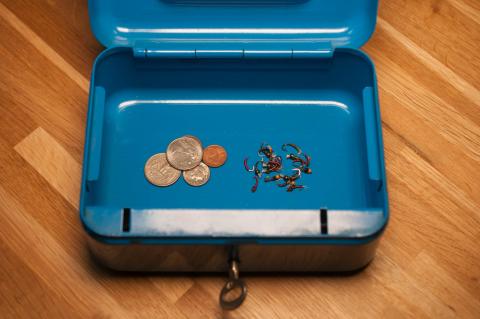
If you get a taste for fly tying, you’ll eventually need to open your wallet. You don’t need to spend a fortune, but you should be prepared to spend some money.
My advice is always to buy decent quality from the start. As a beginner, you’re often tempted to buy cheap because you’re unsure how serious this is going to be.
But poor equipment is a pretty reliable way to reduce the chances of success. A vise that can’t hold a hook, combined with scissors that won’t cut and a bobbin holder that constantly breaks the thread, is a guaranteed path to frustration and poor results.
You don’t need to spend a thousand dollars on a top-tier vise or buy expensive tools, but if you spend just a little more than you initially planned, you’ll ensure that you actually get something that works – and that you won’t need to upgrade immediately if you get bitten by the bug.
There’s a golden middle ground between the cheapest Indian and Pakistani tools and the most expensive brand-name gear, and that’s probably where you should look when starting out.
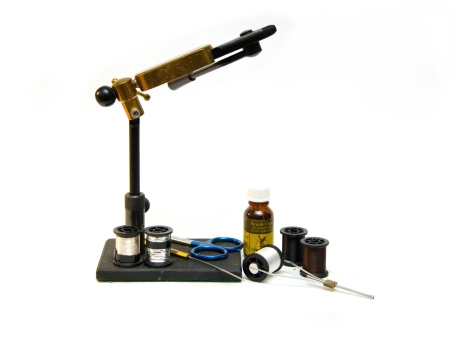
A fly tying vise
Already with this first piece of equipment, a decision must be made.
You can get a perfectly functional fly tying vise for around $80–100. It may be an original model, such as the Danvise, or a copy – most often of a Regal-style vise.
I’ve tied on a Danvise on several occasions, and it works fine, though it feels a bit “plasticky” to my taste.
Personally, I don’t care much for Regal vises – neither the originals nor the copies – but many tyers love them. A good copy can work well, but some are quite poor. The originals are nearly indestructible, but also expensive.
My best advice is to look for an original Regal, Renzetti, or Stonfo vise if you have the budget. Personally, I prefer the Renzetti style, but prices quickly climb to $400–500, which is probably more than most beginners want to spend.
That said, if you do spend the money, you’ll have a vise for life.
Which model you choose comes down to personal taste, how you’ve learned to tie, and what your bank says.
You might also consider buying used. It’s not often that good vises are for sale, but browsing online marketplaces can sometimes save you a lot of money if you’re lucky.
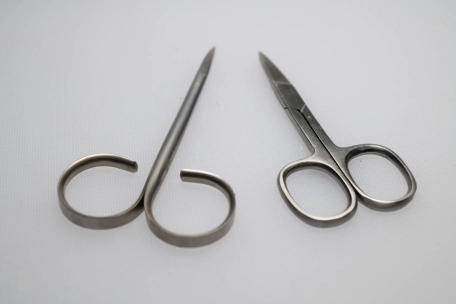
Scissors
You’ll also need scissors, and they need to be good ones. In fact, I recommend buying two: one good and fairly expensive pair that you treat carefully, and one cheap (but preferably still decent) pair that you can beat up.
The good pair should cost around $20 or more and be designed for fly tying. That way you can be sure they actually cut – even right at the tip, which should be fine and narrow. These scissors should be used gently and never for cutting wire, thick feather stems or hide.
For that, buy a cheaper, sturdier pair – perhaps from a hardware store, office supply shop, or supermarket. These might cost as little as $2–3, and you won’t need to be careful with them.
You may already have a small sewing or medical-style scissors at home that you can repurpose as your “heavy-duty” pair.
There's more about scissors ... much more ... here.
Bobbin holders
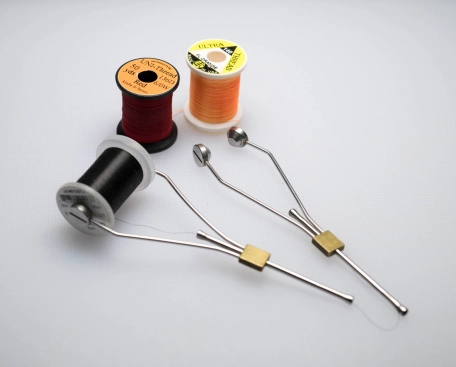
To control the tying thread, you’ll need a bobbin holder. You only need one if you don’t mind changing thread occasionally.
A decent bobbin holder can be had for around $15–30. Avoid the very cheapest ones, but also stay away from the $60–80 models – something simpler works just fine.
The bobbin holder should be a simple Y-shaped model, preferably with a ceramic tube or ceramic insert to prevent thread wear and breakage.
There are good, affordable models to get from Tiemco, FutureFly, Griffin, Stonfo, and others.
There's more ... much more ... about bobbin holders here.
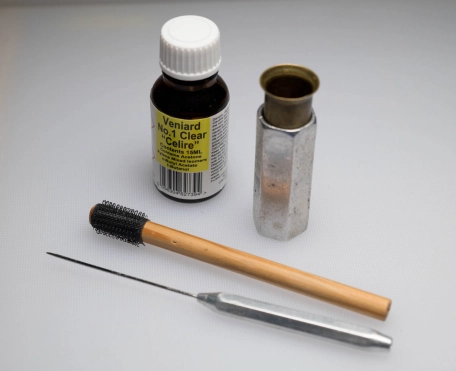
You might also appreciate a threader, a small tool that helps pull the thread through the narrow tube.
Glue and varnish
You’ll need some varnish – sometimes called head cement in fly tying – and I recommend buying something specifically made for fly tying. Many tyers use nail polish, but it’s quite thick and requires a bit of finesse to use. Several thin coats of proper fly tying varnish will produce neat, durable results.
Many fly tiers use super glue on their flies. Personally I don’t use glue, but for some it’s a good way to secure parts while tying. Flies hold up perfectly well without glue, but as a beginner, glue can help lock materials in place between tying steps.
You may also get a lot of use out of so-called light-curing resins (LCR), which are UV-cured glues. They’re great for wing cases, heads, mounting eyes, and other details. Unfortunately, they’re also fairly expensive and require a special lamp. Save that purchase until you know you actually need it.
Other small tools
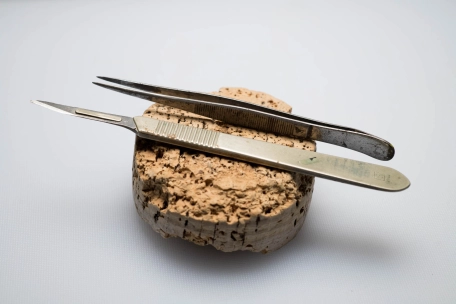
You’ll likely appreciate having a dubbing needle AKA a bodkin, a small Velcro brush, and a sharp knife (a hobby knife or scalpel). Tweezers can also be handy, as can a small pair of pliers or wire cutters for metal wire and bead chain. You may already have some of these things at home.
A small comb is useful for working with hair, and if you need even tips on hair or feather fibers, a hair stacker is nice to have. The quality of a hair stacker isn’t critical, and you can easily buy a cheap Indian or Pakistani aluminum or brass model for around $5.
Some tools can be homemade. A comb can be a regular hair comb, and a dubbing needle or Velcro brush can be made from scraps of wood, a sewing needle, and self-adhesive Velcro.
Everything can of course be bought at the fly shop, and by all means do so if you feel like it – but homemade solutions often work just fine.
Thread
You’ll need proper fly tying thread – don’t think that regular sewing thread will do. Tying thread is much stronger, higher quality, and – most importantly – thinner.
Buy several spools in different colors. Black is essential, red is widely used, and olive, tan, and white are also useful to have.
There are many brands on the market, and it can be difficult to know what’s good and strong, but look for 6/0 (pronounced six-aught) polyester thread.
Note that thread sizing is “backwards”: the higher the number, the thinner the thread. So 3/0 is thick, 6/0 and 8/0 are normal to thin, and 10/0 and 12/0 are very thin.
Some threads are measured in denier, but unfortunately that number doesn’t say much about actual thickness or strength. If you stick with well-known brands like Veevus, Semperfli, or UNI in 6/0, you’ll be in good shape.
To start with, avoid very thin threads (10/0, 12/0), monofilament threads, and GSP threads. As you improve, you can always become more particular in your thread choices.
There's more ... much more ... about tying thread here.
Hooks
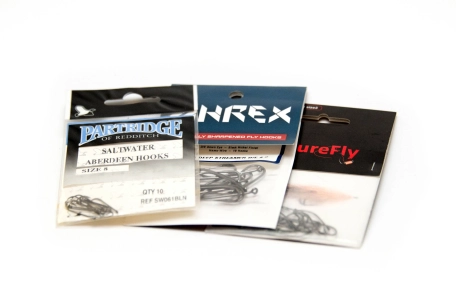
Your hook choice obviously depends on what flies you want to tie. The selection is enormous, and each hook model comes in many sizes.
Hooks are usually sold in packs of 10–25 and can unfortunately be quite expensive.
Limit your purchases to models and sizes you know you’ll use. Once you’ve chosen one or more patterns to tie, buy hooks specifically for those flies.
A good and widely available brand is the Danish company Ahrex, which offers a broad selection at reasonable prices, but if you go for Kamasan, Partridge, Tiemco, Gamakatsu, Daiichi and other well known brands, you should be good.
Materials
This is where giving concrete advice becomes difficult.
Materials depend entirely on what you want to tie, and just like ingredients in a food recipe, the materials list for a fly pattern is essentially a shopping list.
You can go two ways: tie patterns using what you already have, or choose patterns and buy what you’re missing.
In the beginning, you have nothing and must acquire everything. That improves over time as you build a stock you can draw from.
We have a whole article series about how to buy materials.
That said, there are some basic materials that are smart to have.
Hackle
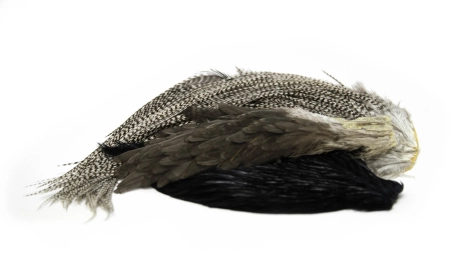
Hackle is feathers – plain and simple. Most often from chickens or roosters, and the selection is enormous, the variation enormous – and unfortunately, the prices often enormous as well.
If you’re buying without a specific pattern in mind, start with grizzly (black/gray/white barred), black, and perhaps one more color you know you’ll need like olive, brown or some bright color such as orange or red. The choice depends on the type of flies you intend to tie.
Notice that there are many types of hackle, like soft hackle for wet flies, dry fly hackle, salwater or streamer hackle and other types. These vary tremendously in quality and use, and you cannot just buy "black hackle" and then count on getting what you need. You can read about selecting and buying hackle in these articles: Buying Dry Fly Hackle, Buying Soft Hackle, Buying Saddle Hackle.
You can buy loose feathers in packs, which can sometimes be useful but are often just randomely plucked feathers shoved into a bag. Size and quality vary widely, and many feathers may be unusable. It can seem inexpensive, but it’s expensive in the long run.
Some packs contain carefully selected and sorted feathers where all are usable – that will give you much better value, even though it’s more expensive than the grab bags.
Best of all is buying full skins, necks, or saddles with feathers still attached. That gives you many usable feathers in a wide range of sizes.
Unfortunately, it’s also an easy way to spend a lot of money. High-quality necks and saddles can cost several hundred dollars each, but they also contain hundreds or thousands of feathers, making the cost per feather low – even though the upfront expense is high.
Consider buying together with others and splitting skins to get more variety at lower cost.
Check bargain bins as well – there are often great finds.
Do NOT be tempted to buy feathers from craft stores. They’re intended for decoration and costumes and are rarely suitable for fly tying.
Other feathers
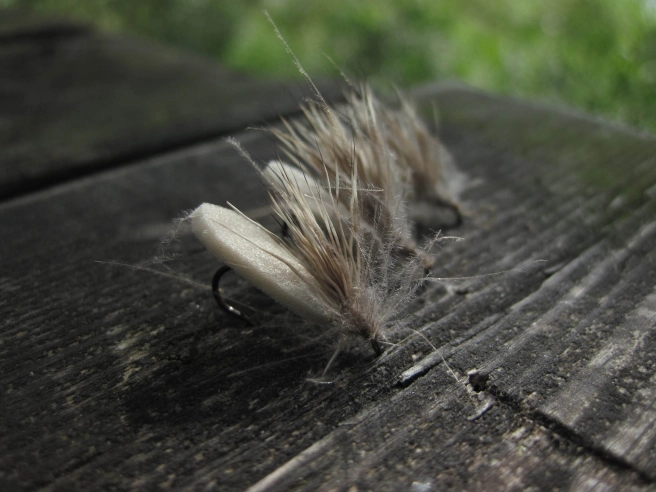
Other useful feathers include pheasant, ostrich, turkey, partridge, guinea fowl, and various ducks. Once you start looking, almost all feathers can be useful in some way.
Fine barred body feathers from mallards are widely used, and teal and wood duck are mentioned in many patterns too. These are usually sold in neatly sorted, high-quality packs.
Peacock herl is also widely used and available in packs or bundles at reasonable prices.
Marabou is essentially turkey down and comes in many sizes, shapes, and colors. It’s used in countless patterns. Read more in Buying Marabou.
CDC-feathers are a special category often used for dry flies. They are only sold plucked in bags, but as with other plucked feathers, the quality varies wildly. You can buy mixed bags with a lot of different feathers - and probably some useless ones - or you can buy bags with sorted and uniform feathers.
For many birds, you can choose between loose feather packs or full skins. Again, skins usually offer the best value, while packs can be a gamble unless they’re well sorted.
Dubbing
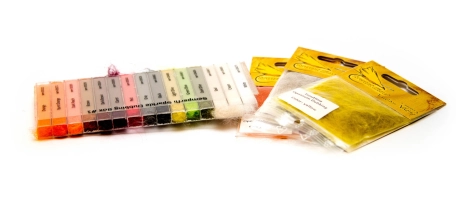
Dubbing is essentially loose fibers, which you spin onto the tying thread or between two threads. It’s primarily used for bodies and comes in an astonishing variety of types and colors.
It’s not terribly expensive, but costs can quickly add up if you want a broad selection. Some shops and manufacturers offer dubbing dispensers, which hold a selection of dubbing in various colors. If you can find a selection that suits you, this can be an easy way to get a decent stock of dubbing.
Consider making your own by cutting fur from rabbit skins and mixing it by pulling it apart with your fingers. You can blend different colors and types and even add sparkle (see Flash below).
Dubbing can also be synthetic like very fine flash or seal substitute, adding subtle sparkle. It comes in countless colors and variations.
You can often substitute dubbing with yarn – and here, you can actually use yarn from a regular yarn store. Just be sure it’s thin; thick yarn quickly makes bulky flies.
Yarn can also be teased or cut into traditional dubbing.
Hooks, yarn or dubbing, and some brass beads – and perhaps some thin silver and golden tinsel or wire – will give you an inexpensive collection of materials for tying very efficient nymphs.
Wire and tinsel
Many patterns require shiny wire in silver, gold, or copper, often used as ribbing. This can be solid metal wire (very thin) or a thread wrapped with a flat shiny band.
It can also be the same type of flat, shiny band wound onto a spool. These tinsels are usually plastic-based and often gold on one side and silver on the other, serving two purposes. They come in multiple widths, with narrow and medium sizes being the most useful.
You may find usable wire and tinsel in craft stores, but make sure it’s not too thick – which is often the case.
Don’t be tempted by Christmas decorations, even if they look right. They’re usually not waterproof and will break, dissolve or bleed color.
Flash
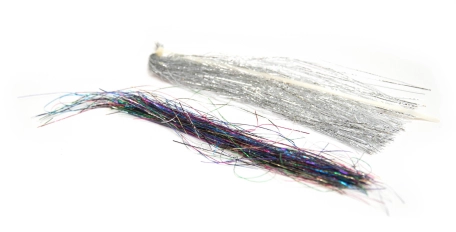
Flash appears in many patterns and comes in three basic forms: flat strips, twisted strands, and dubbing (as mentioned above). Strips come in widths from roughly 0.5–1.5 mm.
I prefer flat strips in packs for tails and wings, and dubbing for blending or adding subtle accents.
The most versatile type is simply clear flash. It often has a pearlescent sheen and works for many applications.
You can get flash in so many colors it becomes overwhelming. Sometimes mixed-color packs are available and are worth buying. Since you usually use only one or two strands at a time, it’s easy to separate out the colors you need.
Fur and skins
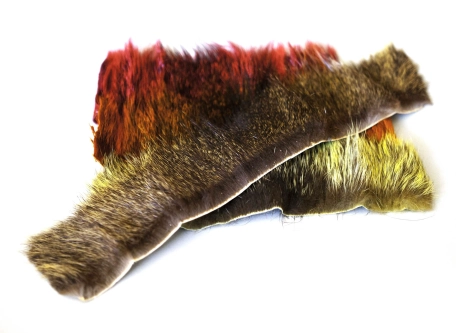
Many flies have tails and wings made from skin (with hair) or loose hair. This is especially common in steelhead, salmon and sea trout flies.
You can often buy small bundles of skin scraps from furriers. As long as the hide is tanned and not too thick or stiff, these are an easy way to build a useful collection.
Rabbit, hare, squirrel, mink, nutria, raccoon, opossum, fox, tanuki and many others are excellent for fly tying.
A special category is fox tails or tail sections, which provide long hair for hair-wing flies. Arctic fox is popular – though it’s rarely true Arctic fox and more often raccoon dog (tanuki) or farmed fox.
Deer hide also contains useful hair, typically for muddler-style flies, which you probably shouldn’t tackle early on. There is more about deer hair here.
One very useful and more manageable deer hair type is bucktail. It comes in many colors and sizes and is fortunately not terribly expensive.
There's more to read in Buying Fur and Skin and Buying Bucktail.
Other useful materials
For certain types of flies you may need eyes. Simple and inexpensive bead chain eyes is a good way to go. Bead chain is sold by length in hardware stores, and is simply the type that you use to secure plug in a sink. They can be found in many sizes, and getting something appropriate for your fly usually isn't a problem.
You can also buy heavier dumbbell eyes or lighter plastic eyes in flyshops.
If you venture into shrimp tying, special shrimp eyes can be very convenient. You can buy them ready-made or make them yourself.
Foam can be useful, and as a beginner you will probably do fine with hobby foam, which is inexpensive and available in many colors and thicknesses.
Various kinds of plastic string can be useful too for bodies, legs and antennae. So called jewelry string or wire in translucent plastic comes in many colors and diameters.
Rubber legs is a similar material, but much more mobile. Rubber legs need to be water resistant and should not dry out. Don't be tempted to use rubber bands, which go dry and break after short time.
Consider yourself warned!
Once you start tying flies and catch the bug, let me immediately issue a warning about materials.
There are many more types and a much larger selection than what I’ve mentioned here.
Most of us who’ve tied flies for years probably have enough materials to supply an entire tying class for multiple seasons!
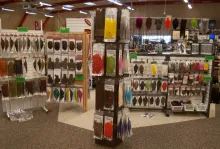
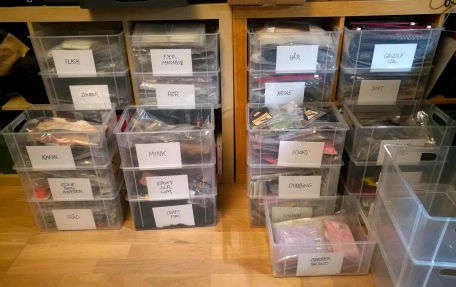
It easily becomes an obsession. Personally, I can’t approach a bin, shelf, or wall of fly tying materials without just having to check whether there’s something useful there – and nine times out of ten, there is. A bag or two goes into the basket, and when I get home, I cram it into an already overstuffed box of exactly that type of material.
This is NOT a good beginner strategy!
Instead, buy very carefully what you need for the flies you plan to tie and resist spur-of-the-moment purchases. Even with a cautious approach, you’ll be surprised how quickly one box with tying materials turns into two … or three … or ten.
A place to tie
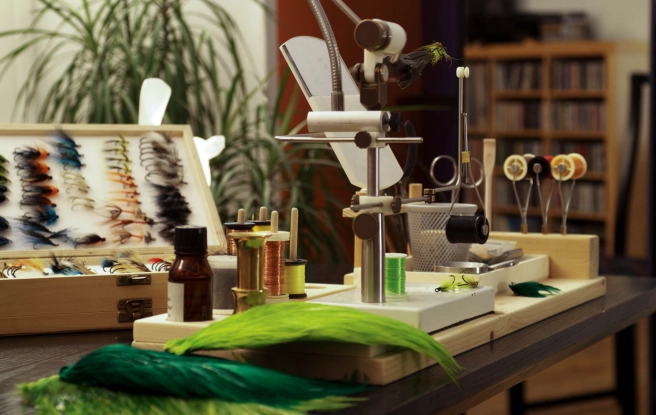
You don’t need much space to tie flies. A seat at a dining table or a writing desk is usually sufficient.
If you can’t dedicate a permanent space, consider what’s called a tying station. It’s simply a board that holds your vise, tools, and perhaps some materials.
It’s easy to move, and everything is mounted and ready to use.
You can buy a ready-made station or build your own. A piece of board or plywood from a hardware store makes a great base. Small boxes or blocks with drilled holes can hold tools. Read more in A Flexible Bench.
You’ll also want a lamp unless you’re tying in good ambient light. A small, flexible LED lamp works well and is easy to find. Lamps are covered in detail here.
Materials can initially be stored in one or two plastic boxes with lids. Stock up on zip-lock bags to keep things organized.
Over time, you may need more storage – but by then, you’ll be at a different stage in your fly tying life and ready for more elaborate solutions.
Tie simple flies
It may seem obvious to recommend simple flies for beginners, but I’ll do it anyway.
Simplicity serves several purposes. Simple flies are often easier to tie (though not always), and they typically use few, common materials – perfectly aligned with the idea of not buying too much.
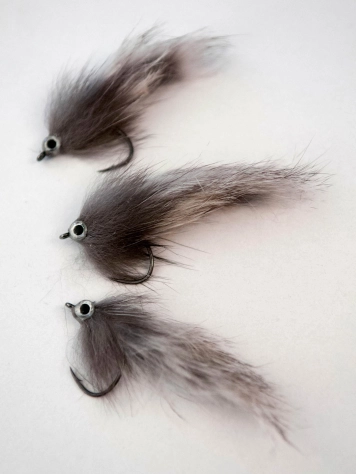
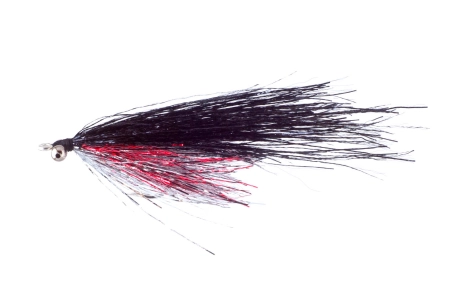
For Baltic saltwater anglers coastal flies like Grey Fred, Red Tag, Woolly Bugger, and the ultra-simple Copper Bully (“Kobberbasse”) are excellent choices. They’re easy to tie and catch fish.
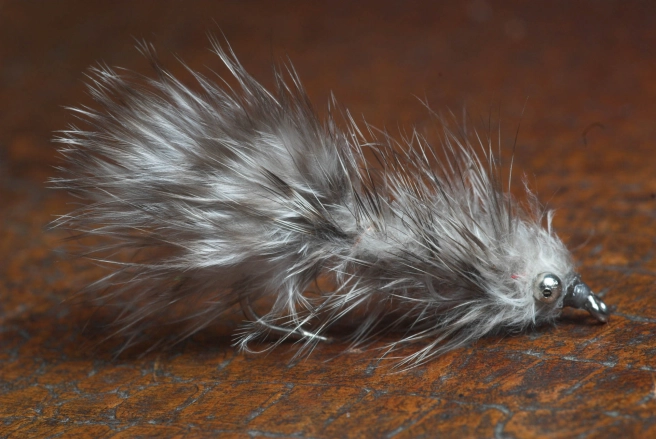
If you fish tropical waters Crazy Charlies and Gotchas are easy to tie, and for larger saltwater fish various simple, colorful streamers will do fine.
Bass fishermen can do well with Woolly Buggers, Clousers and various leech patters, as well as streamers, which in many cases are easy to tie and require few, common materials.
Easy pike flies include various flash streamers and bucktail streamers.
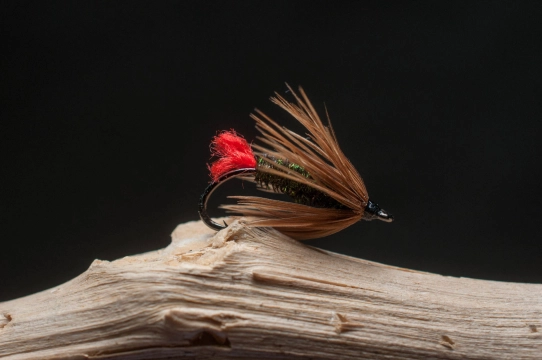
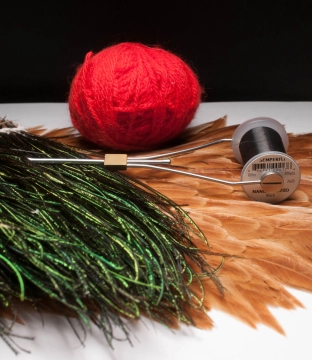
For salmon and sea trout in rivers, many modern zonker-wing patterns using a strip of fur for the wing are good options. Some are very simple and place few demands on the tier, as do classic hair-wing flies like Green Butt, Blue Charm, and Undertaker. Some salmon flies are tied on tubes, which is its own discipline, but most can easily be tied on hooks.
If you prefer nymphs or dry flies, simple bead-head nymphs and jigs are very easy to tie, and extremely efficient fishing flies. On the dry-fly side, deer-hair wing patterns like CDC&Elk or Elk Hair Caddis are great choices. At the very simple end, you’ll find flies like the Rackelhanen, which uses only one material.
Save advanced shrimp patterns, muddlers, and parachute-hackle dry flies for when you’re more experienced.
Tie identical flies
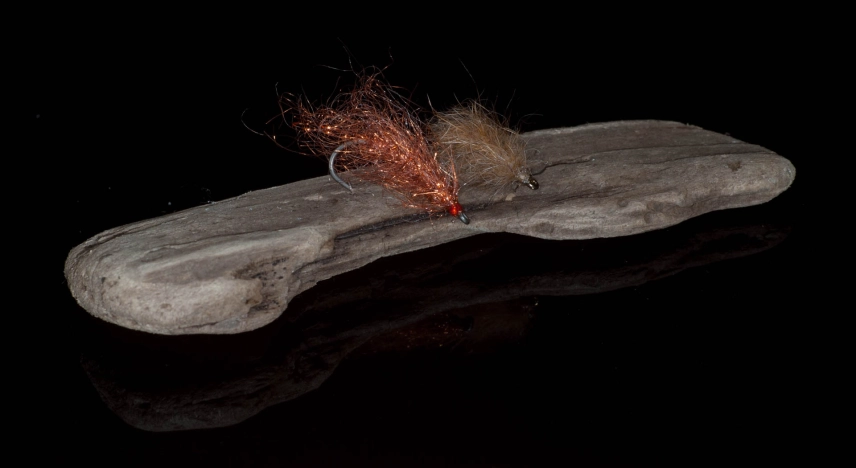
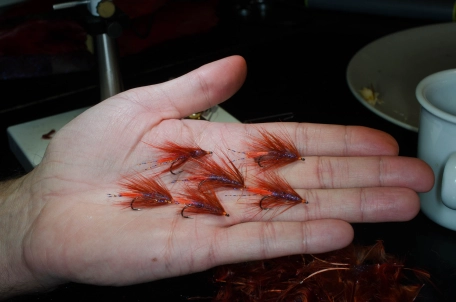
If I’m to give one final piece of advice before leaving you to your potential fly tying odyssey, it’s this: tie identical flies.
By that, I mean both tying many flies of the same pattern and striving to make them uniform – same proportions, same material amounts, same shape.
Choose one or a few patterns that you like and that you fish with often, buy hooks and materials for those patterns, and tie many copies. Follow the pattern recipe so your flies resemble the original.
Resist the urge to improvise or vary things. Instead, aim to make your flies as identical to each other – and the original – as possible.
This builds good habits and solid technique, and it results in better-looking flies. It also ensures you have exactly the materials you need and don’t substitute or omit elements because you suddenly had an idea for a variation.
You can always vary – and even invent your own flies – once you’ve gained more experience.
- Log in to post comments