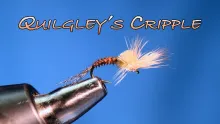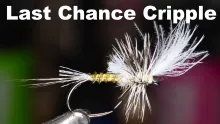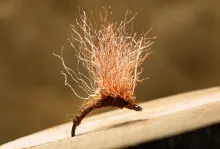
Sometimes hatching fails completely and the unfortunate insect is trapped half in and half out of its previous skin. That’s what the Shucked Up is designed to imitate

Ask an angler to describe a dry fly and they will probably mention tails, a dubbed body with turns of stiff hackles at the front and maybe wings made from feather tips. That’s fair enough, there are an awful lot of dry fly patterns that comprise precisely that. Some may date back to the halcyon days when some select people had enough money and spare time to go fishing on chalk streams with more hatching flies than you could shake a rod at. They saw trout eating flies off the surface and tied flies to match the ones floating downstream in front of them.
Nice looking flies
Wanting their flies to sit up nicely on the water like the real ones they added stiff cock hackle fibres at the back and wound turns at the front to add areas of water contact that would help spread the weight of the hook and thus keep the fly afloat, for a while at least.
They caught fish on their nice looking flies and on some rivers changed the rules so that only dry flies were allowed at certain times of the year and then only provided that you only ever cast them upstream. Anything else was deemed as not proper fly fishing, beyond the pale and tantamount to poaching. I guess when you own the land, can afford to employ river keepers to mow the banks and cut the aquatic weed so your carefully crafted flies don’t get hung up and made all scruffy and sink you may tend to develop a sense of superiority.
Look up, rise
They caught lots of fish. Back in those days their streams rose crystal clear from chalk aquifers and the cool alkaline water supported a healthy and diverse population of aquatic life including trout. There were so many insects and so many fish that it probably skewed the normal predator-prey relationship between flies and fish. Predators, be they trout or lions, generally prefer to hunt efficiently which means balancing calories expended in chasing food against calories gaining by eating it. If there happens to be an abundance of food they don’t have to worry about it, and the trout on those chalk streams certainly didn’t. They didn’t have to compete among themselves, all they had to do was look up, rise at the right time and open their mouths.
Food that isn’t going to fly away
The gentlemen anglers were no doubt happy with their fishing, but the unique character of those chalk streams and the behaviour of their trout do not transpose to how trout predate insects on other waters or even on some of those same streams today. On rivers and streams which have less insects either naturally or due to water abstraction, pollution or rising temperatures trout have to be more active in pursuing their prey. They behave in the same way as any other predator; they favour food that isn’t going to run or fly away. Just like lions will pick out the weak or sick wildebeest or zebra if they can, trout prefer to eat emerging insects that can’t fly away and waste their time and energy.

Sometimes it fails completely
Insects emerging from their nymphal exoskeleton are vulnerable for a short period of time. They are doing what for us would be like trying to get out of a snug fitting hooded sleeping bag without using our hands. Now imagine doing that in a tent by a river in Alaska when you can hear something heavy trudging through the sedge grass outside. Ask me how I know.
Sometimes the extraction process goes quickly, sometimes it does not - sometimes it fails completely and the unfortunate insect is trapped half in and half out of its previous skin. That’s what the Shucked Up is designed to imitate. The key to the making the shuck which is the defining part of the design is a sewing material.
Ever on the lookout for new materials
Some years ago, my wife was cutting out cloth for a shirt and there were offcuts of a white mesh lying on the floor under her sewing table. Ever on the lookout for new materials that can be attached to a hook I picked some up and asked what it was. It turned out it was polypropylene interfacing. This non-woven mesh is used in dressmaking sewn between layers of cloth to add rigidity to thin materials for collars and cuffs. It’s also widely used for the inner covers on pillows and for industrial filtration. It comes a range of weights and thicknesses. For shucks I use 30 grams/m2 mesh which is 0.2mm thick. I got a square metre for less than £5 which is a lifetime’s supply of shucks. The material’s fibres are bonded as the hot filaments are laid down and the resulting mesh is very strong. It’s actually a pretty versatile tying material which can be used to make wings on caddisflies and moths and for bodies on pupae and dry flies.


The concept for the design of the Shucked Up was to incorporate two parts, one representing the ghost of the old nymph at the back and in front of that an abdomen, thorax and wing representing the adult stuck in its struggle to complete emergence. Half-in, half-out, and totally shucked up.


- Log in to post comments