Recent comments

Submitted by Kuttycrew on

Permalink

Great, do I really need to see this kinda slang in my hobby? disappointment......

Helmut,

I contacted Allan and he writes:
"Hi Helmut
I do not so much to sell flies when I unfortunately is ill at present
hope you can take The challenge in trying step by step fly
all the best Allan Kuhlmann"

You will have to take up the challenge and tie some flies yourself it seems.

Martin

Submitted by Helmut Meyer on

Permalink

Hi, I am writing from Germany.
Is it possible to buy flies from you?
Do you have any informations bat. style, sizes and prices?
Many thanks and best regards
Helmut

Submitted by Phil Ewanicki on

Permalink

A big advantage of UV epoxy is your choice of viscosity - thin or thick - for when you wish your epoxy to run and penetrate, and when you don't. Thick and thin LCR are compatible. They greatly simplify tying patterns such as Surf Candy. A third type, flexible LCR, comes in handy for some applications. Great stuff, and so little waste the effective cost is relatively low.

Submitted by Willie Ostiadal on

Permalink

Hello Niels,
is that Phoenix #10 weight-line a DT
and what linesize is you Mc Ginn please?
Thanks for giving me answer.
Willie Ostiadal
Chieming Lake Chiemsee, Germany

Submitted by Jack Maloney 1… on

Permalink

When my Fiance and I were looking at a new home to purchase, we saw this house. It was being converted into an in-law apartment in the basement. The first thing I noticed was the old cabinets that were already in place. I quickly dubbed this are "Mine". The drawers are filled with tying supplies, I have a TV hooked up to my laptop, so I can stream Netflix or check out the latest patterns people post to Facebook or Instagram. There is also a radio for listening to tunes while I tie away. I still need to organize the shelves a bit, but so far, it's my own slice of solitude.

Keith,

I don't know if the ides are on the fins in April, but I'd think so. We usually see them later in the season on the Baltic coasts, but my guess is that they are in the Odense Aa all year. You can give them a try if catching lost of sea trout gets too boring...

Martin

great article! I love Ide and have caught them in Sweden, Karlstad. I am coming to Fyn in April, would there be any Ide around that early? I believe the river running through Odense has Ide, would that be a good place to try? We will be sea trout fishing but I would like to try for ide as well.

Submitted by McFlyLures on

Permalink

Spelling mistakes happen, were not all perfect. I personally have always been bad at spelling and language, so it happens more with me then most. Sorry to all the grammar natzis out there... haha!

Some people are good at language, others at math, etc... you might be good at English, and language in general. Maybe your also good at math, not sure. We just aren't all the same. I was doing advanced algebra at 4 years old, however couldn't pass English classes to save my life. I don't think negatively about people who can't do math, because I rejoice in their strengths not their weaknesses. I hope those who have a problem with misspelling can understand that as well.

Jeff,

If their/there/they're, too/two, it's/its and lose/loose is your battle, you are basically bound to lose (pun intended).

Even I, as a non-native English speaker, find these errors all the time, and even though they do bother me, they don't take much away from my appreciation of the fact that people actually make great content (like this video) that I can read and watch for free. Sure it would be nice if everything was spelled perfectly, but that's not the case I'm afraid. And the errors are becoming more and more common. That's part of how language develops.

I'm sure the spelling control simply convinces people that all is OK - and that time will roll over us ant *beep*'ers as many of the "alternative" spellings eventually will be allowed and finally the norm.

Dame Juliana spelled the title of her book "A treatyse of fysshynge wyth an angle". She would probably roll over in her grave if she saw it written "A treatise of fishing with a rod" as we would do it today.

Martin

Submitted by jeff monik on

Permalink

Just curious, why did you spell lose- loose? I see this all the time, do you not know better or why exactly? thanks

Robb,

The eyes are usually made out of metal, lead, tungsten or brass. These are painted, which is sometimes available, but can be fixed with some nail polish if you can't find them painted. Size depends on hook size, but these seem to be about 2.5 mm or maybe 3 mm in diameter. It's probably not critical.

Martin

Submitted by Robb wall on

Permalink

Great fly.......what are the dunbell eyes made out of and what size are they thanks

Submitted by Daniel Smith 1… on

Permalink

Thank you for the post

Submitted by Dominick Bet on

Permalink

Jim, you are one of the best fly tyers that I enjoy watching. I like the leach pattern, but do not have bird fur. I use maraboo feathers instead. I like to keep a slightly shorter tail; so that I don't get short strikes. I usually fish for hatchery trout and they seem to like any type of wooley bugger, especially black. I also like to keep my hackle long and close to the chenille body so that it moves, but does not stick out; sort of like a wet fly type of longer hackle. It works for me. I think you are a great instructor. My suggestion is that you also tell tyers that they can subtitute materials that they have in their tying table, like maraboo instead of bird fur. I am not familiar with bird fur. Keep up the excellent work, I enjoy watching all of your videos and you provide and excellent service to all of us amateurs. Thanks again. Dominick

Jerry,

Unfortunately not... you will have to watch the video and listen to the instructions where the materials are mentioned as they are used. Or you can ask the originator by going to YouTube and posting a comment on the video.

Martin

Submitted by Jerry Childress on

Permalink

Could you please send me a list of the materials needed to tie this perch pattern?

Thanks
Jerry C.

Submitted by Tom on

Permalink

This is a great article and beautiful photos and patterns. I have been trout fishing for over 50 years but have never used or tied wet flies or soft hackles. I have just been a nymph, streamer, dry fly guy but just this year have gotten interested in fishing wet flies and soft hackles after talking to an elderly retired doctor in Wisconsin who started the first TU chapter in central WI. He has forgotten more about fly fishing that I ever knew. I can't wait to try what I have learned this next season and use the flies I tied. Thanks again for a very informative article.

Submitted by Jay Murakosh on

Permalink

I was given one of these back in the early 80's by a great fly tyer named Edie Mashiko. The only difference between the one today and the original one is the insert. Back then Edie used a chore girl. Some of you younger people might not know what that is. it's a copper scrubbing pad made for cleaning pots and pans. I would have to think that it's much coarser and durable than steel wool. My cleaner is still going strong after 30+ years of use.

Since you got this far …

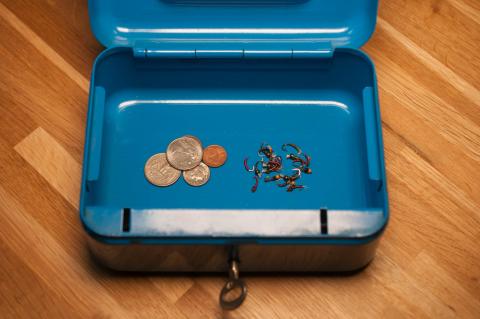
A money box
The GFF money box

… I have a small favor to ask.

Long story short

Support the Global FlyFisher through several different channels, including PayPal.

Long story longer

The Global FlyFisher has been online since the mid-90's and has been free to access for everybody since day one – and will stay free for as long as I run it.
But that doesn't mean that it's free to run.
It costs money to drive a large site like this.
See more details about what you can do to help in this blog post.