








Tube Fly Turmoil
Tube flies are flies tied on a tube rather than a hook. But putting it that simple is almost a crime, because tubes have evolved dramatically over the last few years, and bottles, rear tubes, Shomakov tubes, FITS tubes and all sorts of new systems have seen the light of day.

Orange and black fly with beads
|
An introduction to the concept of tube flies and some arguments for using tubes rather than hooks.
All kinds of tubes in an overview. Want to get an idea of the richness in the tube fly world? This is one place to look.
Trying to grasp the many different styles and types of tubes available out there can be almost impossible. This article tries to set things straight and cover most of the tube styles currently on the market.
This article dives into the different vises and tube fly holders, which is a world full of strange and complex contraptions as well as very simple devices.
Tying on tubes is not unlike tying on hooks. This article tries to cover a small selection of the many different ways a tube fly can be tied.
There are as many tube patterns out there as you can name in a lifetime, and there are so many different styles of tying. But this article still tries to bunch them into some common groups.
Want to go further than just this tube fly theme? Here are all the books, DVD's and web sites worth getting acquainted with.
Tube flies have long been stable flies for many salmon anglers all over the world, and these practical flies have also been adopted by salt water anglers in need of large flies. But tubes can be useful to almost any angler apart from those using the smallest of flies.
We frequently show tube fly patterns on the site and not rarely does that spawn some questions about the ins and outs of these flies. This theme will try to introduce newcomers to the basic concepts of tubes and pile some knowledge on top of the basics to extend a bit further on the subject.
Reasons why
There are several good reasons to tie and use tube flies:
- You separate fly and hook. Trash the fly and keep the hook or vice versa
- You can avoid the fly becoming a lever in the mouth of the fish
- You can tie large but still light flies
- You can tie some very heavy and compact flies
- You can construct some very special flies
- Tubes can be inexpensive (but also the opposite)
I will cover each of these arguments in further detail as we go along.
Below you see a bunch of flies tied in the traditional Scandinavian style, but tube flies are much more than that, which this theme hopefully will demonstrate. To the right you will find links to the different articles in this theme, but you can also use the keyword tube flies as an entry.
You can get an idea about the richness of tube flies by browsing this tube fly plate, which barely scratches the surface of tube fly styles.

Black Back
|

Copper Streak
|
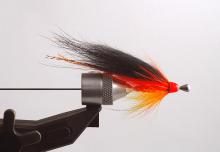
Germaniac tube fly
|

Green Finish
|

Lowwater Blues
|
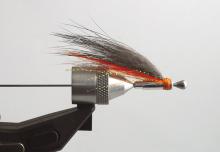
Orange André
|
Read more about why you should register.
Related content



More content from the front page


Since you got this far …
The GFF money box
… I have a small favor to ask.
Long story short
Support the Global FlyFisher through several different channels, including PayPal.
Long story longer
The Global FlyFisher has been online since the mid-90's and has been free to access for everybody since day one – and will stay free for as long as I run it.
But that doesn't mean that it's free to run.
It costs money to drive a large site like this.
See more details about what you can do to help in this blog post.

Comments
My brother-in-law, P
My brother-in-law, Peter Harding Rolls, has been a wonderfully expert and successful fly fisher all his life.
He caught some beautiful 30 lbs salmon in Tillamook Bay when he visited us in 1988. His arthritis now makes it difficult for him to tie his flies. Could you possibly suggest techniques to solve or ease this problem? If you can help, perhaps you could email him direct in the UK: plhrolls@talktalk.net. Otherwise I'd be happy to pass on any advice you can give me. Very many thanks.
Great job, Martin an
Great job, Martin and GFF Staff!!
You wrote a complete book about tube flies. The best guide book we can see.
Congrats!
Carlos Heinsohn
Thanks.Just started
Thanks.Just started tying tube flies. In the 20 minutes that I spent reading your " ...Turmoil of Tube...", you have given me more insight into the nature of tube tying, than the many, many, many hours that I've spent trying to get the same information from the web. Seeing all the different tube types & etc. in one place can only help accelerate one's progress in tying tubes. Looking forward to more!
Thanks, again
Great! Waiting for t
Great! Waiting for the next tube articles :)
Your B.I.Law Peter
Hello there....about the arthritis thing...I know it was an old post..but I just found you guys!! I had arthritis in both basal joints of my thumbs...since fixed with fusion surgeries...but...it was very difficult for me to do many things...tying one of them...I tried to MacGyver all of my tools so the handles were all oversized...Making it more comfortable to hold...they look odd...but if it works for him....awesome. prayers for relief and healing....Tom