






Beads and eyes
Beads or eyes are added for one or both of two reasons: weight and appearance. The eyes and beads discussed here are made from metal: brass, steel, lead - even tungsten. This will make them heavy and thus add weight to the fly. The weight will bring the fly down and often give it a certain behavior - a diving or jigging motion. But it will also add to the looks of the fly, the most obvious case being eyes added to fish or fry patterns like streamers.
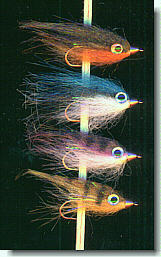
Eyes and cones - Austrian trout flies by Roman Moser
Beads or eyes are added for one or both of two reasons: weight and appearance.
The eyes and beads discussed here are made from metal: brass, steel, lead - even tungsten. This will make them heavy and thus add weight to the fly. The weight will bring the fly down and often give it a certain behaviour - a diving or jigging motion.
But it will also add to the looks of the fly, the most obvious case being eyes added to fish or fry patterns like streamers. They really look like the eyes of the fish they're supposed to imitate. But also the shiny bead added to many larva or nymph patterns will act as a visual enhancement as well as a weight.
I don't fish jigs!
I know a few fly fishers who almost never tie and certainly never use a fly weighted with a bead or eyes. 'If you want to fish jigs, use a spinning rod' they will say.
Well, I respect that view, but absolutely do not share it. I will gladly use a bead head pattern on any stream and most of my favorite salt water patterns have eyes of some kind. I don't particularly like the heaviest patterns with heavy wire hooks and lead dumbbell eyes, but I admit that my limit is flexible and that I sometimes fish flies that are quite heavy.
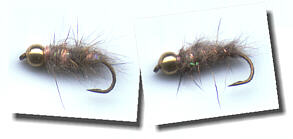
A small addendum to the bead head story by Bas Verschoor
I took my first beadhead nymphs with me to Montana and Idaho in July/August 1982. There I showed them to flyfishers and tackle shop owners. They all gave me strange looks, asking me with some disbelief ... "Can you really catch fish on these?".
I fished the Gallatin, the Yellowstone and the Madison with them, and... literally
"knocked 'em dead!". Took a 58 cm, (23.2 inch) brown trout on the Madison, between Hebgen and Quake lake... a fish I'll never forget. Yes, Sir....I'm a beadman all the way!
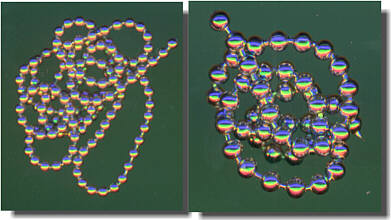
Bead chains: inexpensive and easy to use. Adds weight and good looks.
They come in many different sizes.
Rows of eyes
I use a lot of bead chain eyes in my patterns. They have several advantages - but unfortunately several disadvantages too.
Like many other fly tying materials these bead chains are not made for tying flies, but are used for several other purposes amongst which holding bath tub plugs, roller ball pens and keys are the most common.
The chains should be widely available, and most hardware stores or locksmiths have them. But getting them in the smallest sizes can be a problem. Many fly shops pack small pieces of chain of appropriate sizes, These are unfortunately sold at some hefty prices, but can be a last resort.
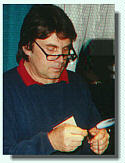
Austrian Roman Moser - one of the modern revivers of the bead head.
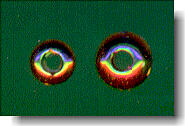
The very common brass beads come in many sizes
Some advantages of these eyes are:
- Very eye like
- Shiny and stainless
- Inexpensive
- Easy to handle
- Adds a little weight but not too much
The disadvantages are:
- Sometimes too light
- Often has sharp edges that can cut tying thread
Beads add weight and a shine of gold
Beads are the classical way to add weight and shine to a fly. The beads as we know them have been around for ages, and their history probably go centuries back.
Many of the most common bead head patterns use the brass or gold bead, which is widely available in many sizes. Almost any wet fly can be equipped with such a bead - if not for beauty then for effective, deep fishing. Some fishers also advocate that the shine of the bead will be an added attraction for the fish, which does not seem an unlikely theory. A theory along the same lines goes that the gold bead imitates the air bubble that most emerging insects, (particularly caddis pupae), have in their bodies, enabling them to rise to the surface.
Most of the beads have fairly large holes through them in order to facilitate passing the bead over the barb and the bend of the hook. If the bore is not wide enough the bead will get stuck while passing the bend. This can be overcome.
Some Europeans use slightly different beads in which both holes are uniform. Consequently, they are a bit heavier. But, more importantly, these beads are gold plated and will keep their shine. Most beads available will eventually get dull.
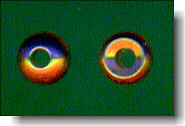
The beads often have tapered holes for easier passing over the hook bend.
Size matters
The size of the bead will depend on a few factors: hook size, pattern and desired weight.
I've seen small flies with humongous beads - and they've worked fine. But generally the beads are chosen in sizes that harmonize with the hook and the pattern. Small fat nymphs can bear relativly larger beads than slender streamers. This is mostly an aestathic consideration, but still. Some of the problems can be overcome by using cone heads which blend better into most slender patterns.

FMJNM
|
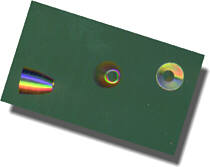
Roman Moser's slender brass cones used for the FMJNM.
Just a bead with a different shape?
I have always been a big fan of the bullet shaped beads - also known as cones. These will in my opinion lend much more style to a fly that any round bead. The round beads are very common though, and the overall effect is excactly the same.
Integrated part
The cone shape seems to integrate better with almost any fly. Good examples are Bas Verschoor's Coney flies, which could be tied with round beads, but look much better with Bestco's cones.
My own cone headed Nutria Muddler would not be the same with a round bead or two and even the banal Woolly Bugger type of fly like the Magnus can benefit from the aerodynamical shape of a cone compared to a round bead.
Cones can be split into many types. The most ordinary one is the conical brass cone, but cone heads come in many shapes, materials and colors. The newest cones are extra heavy tungsten cones.
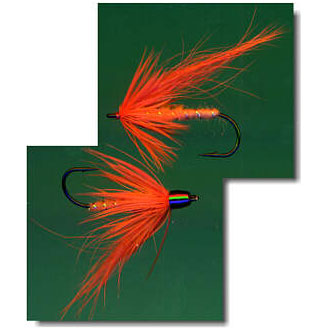
Orange Devil
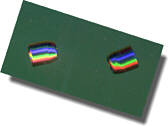
Cones and eyes from Bestco - a company that can deliver a large assortment.
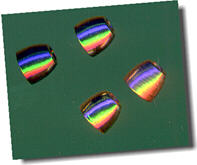
Tying on eyes - You don't want to see rolling eyes
Tying them on
Many tyers have a hard time getting almost any type of eyes or beads to sit properly. It seems that eyes will always twist and beads always slide up and down the hook shank when the fly has been cast a few times. But it doesn't have to be that way.
The very simple and almost rude solution is super glue. These glues - also known as cyanoacrylates - are extremely strong and will bind two metal objects very tightly together. Add a small drop after the first few turns of tying thread and the eyes will probably sit there forever.
This approach can also be used for beads: add a drop before the bead is slid onto the hook shank.
A major problem with this method is controlling the amount of glue. The small dispensers only set one drop at a time, but one drop is often much too much. The glue has a tendency to creep out everywhere - especially into the eye of the hook.
But luckily there are alternative and maybe more elegant ways.
Eyes
Before tying on any pair of eyes you should consider whether they should be on top of or below the hook shank. Most tyers will put the eyes on top of the shank - mostly because it's the easiest way when the hook is upright in the vice. But it's not necessarily the best way. The eyes will add weight on top of the hook and unless you want to tie an upside-down pattern such as a Crazy Charlie (or a Crazy Dane) you should put the eyes below the shank. Turn the hook upside-down or rotate the vice before tying on the eyes.
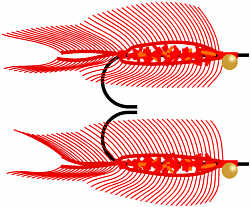
The placement of heavy eyes govern whether the hook point will be up or down like on this Red Fly for cod.
Tying on pairs of eyes can be quite frustrating. Bead chain eyes are often cut into pairs before they are used, which can make them quite hard to handle. In stead you should leave them as a chain, secure the outmost pair on the hook shank with a few tight turns of thread and then cut.
First tight turns
Any set of eyes should be tied on by starting with a couple of turns in one diagonal direction to fix them. If you want to glue or varnish this is the time to do so - while there's still free space between the metal of the eyes and the metal of the hook shank.
Now start crisscrossing thread over the base of the eyes. These first turns of thread are the most crucial ones. If they are not tight, the rest won't be either and the eyes will soon loosen and start rotating. Tighten the thread on the upwards motion (or the motion towards the side that the eyes are on). This will keep the eyes from turning when you pull the tying thread.
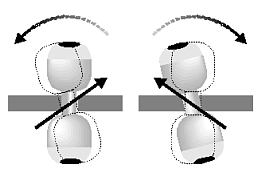
The solid arrows indicate the way the thread passes over the eyes and shank.
Look at the eyes while doing this. Every turn going lower-left to upper-right when seeing the eyes from above will turn the eyes clockwise in respect to the shank, and every turn lower-right to upper-left the opposite. This effect can be used to adjust the eyes to sit absolutely perpendicular to the shank.
When they are set, you can fix them very effectively by taking some tight turns of thread vertically over the hook shank but under the eyes (with the eyes on the underside of the shank). Do not criss-cross here, but go over the shank away from you behind the eyes, under the far eye, over the shank in front of the eyes towards yourself and under the near eye. This will tighten the diagonal turns of thread further and set the eyes very firmly on the shank. Finish with a few criss-cross turns of thread, and the whole thing should be very tight.
After finishing the fly you can cover the thread and base of the eyes with varnish or epoxy.
Tying on beads
The bullets and beads need to be slid over the hook shank and end up close to the eye. In order for the bead to pass the barb and the bend of the hook, the bead will need to have a fairly large hole. This is somewhat overcome by the conical holes that most beads have nowadays. Slide the bead over the hook with the small hole first.
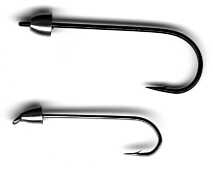
Just as the cones, the beads will sometimes be loose on the shank. Roman Moser corrects that by pushing some dubbing into the hole, while Bas Verschoor corrects the position of the cone by shoving some very thin lead wire into the rear opening.
It often pays to prepare a bunch of hooks with beads or cones before tying the fly as such.
The bead still might not be able to pass the barb or the bend. You can press down the barb, which will help in most cases. But if that plus a bit of mild violence does not work, you'll have to select a hook with a larger bend.
That could be a larger hook size, but alternatively a special bead head hook might be the solution. These have short shanks and large rounded bends yielding a large hook gap.
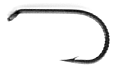
Special bead head hook. Captain Hamilton from Partridge
Tight fit
You can use several approaches to get a tight fit between the hook and the bead. I usually make a small cylindrical thread wrapping in the front of the hook and slide the bead over that. This requires that you whip finish and cut the thread, but I find the result more harmonic, as it places the bead centered to the hook shank.
Most tyers prefer to slide the bead over the naked hook and superglue it in place, while others secure it by wrapping a bump of thread and/or body material just behind the hook.
Bas Verschoor has solved the problem by using cyano acrylate paste. The paste has a slower setting, about 60 seconds, which gives you a bit of extra time for the whole operation. Cover the shank of the hook first with a dozen wraps of thread, and whip finish. The cone or bead should already be on the hook. Apply a bit of paste with s needle and slide the cone up front over the wraps and paste.
If the cone is not properly secured it will almost certainly loosen while you fish with it. The stress put on the bead in the cast will make it move along the shank and make it into a small compression piston that will work hard to make the fly half as big as you intended it to be.
Contact
Normal round brass and tungsten beads, bead chain and dumbbell eyes are available in most fly shops. But some of the special beads, cones and eyes mentioned here aren't easily found. Try to contact:
e-mail : bidoz@bidoz.com
Roman Moser Products
Read more about why you should register.
Related content


More content from the front page


Since you got this far …
The GFF money box
… I have a small favor to ask.
Long story short
Support the Global FlyFisher through several different channels, including PayPal.
Long story longer
The Global FlyFisher has been online since the mid-90's and has been free to access for everybody since day one – and will stay free for as long as I run it.
But that doesn't mean that it's free to run.
It costs money to drive a large site like this.
See more details about what you can do to help in this blog post.

Comments
Matt, Well, no wa
Matt,
Well, no water to fish doesn't mean you can't practice! Tie a couple of flies on a leader - a beadhead as the dropper and one light nymph as the point fly. Cut off the hook points and go practice on the snow! The white cover will make it easy to see if the flies land properly! Practicing on a lawn can be a great way of getting in shape before the ice breaks and the streams clear up.
Be prepared and beat the *beep* out of your fishing buddies when the spring comes... ;-)
Martin
Martin, Thank you f
Martin,
Thank you for your response. That makes sense. Learning to cast that way (and targeting a shorter distance) will also ease in the task of mending my line. I wish the rivers here in Ohio would thaw out so I can continue practicing. Thanks again.
Matt
Matt, The answer
Matt,
The answer is both yes and no. The weighted fly will get down, which is the primary reason to fish with a split shot on your leader. But the problem is that the heavy fly will behave different compared to an unweighted one, which moves more freely.
Fishing with split shot or several flies can be a curse, and even the seasoned fly angler will tangle occasionally. The remedy is to learn to cast properly, and a slow and open casting stroke will generally make it easier to control the flies. And don't be too ambitious regarding distance! Long casts will most likely make it worse. You can also take this to its extreme, and opt for a "European" fishing style, high sticking or a similar technique, which does not require casting as such. And don't be fooled by this, because these methods can be very productive.
Martin
I hate fly fishing w
I hate fly fishing with a split shot. I am relatively new to fly fishing and have a tendency to get the split shot tangled with my flies. I am sure this is a rookie mistake (and I plan to take lessons to improve my casts) BUT in the short term, fishing a weighted fly would/could eliminate the use of a split shot correct?
Jan, Unfortunatel
Jan,
Unfortunately I don't think Bestco exists anymore.
Martin
Martin, could you
Martin,
could you give a hint where to buy Bestco Coneheads in Europe, I didn't fint them.
Thanks
Jan
janw