Foam is used in many fly patterns, but foam isn't just foam. Here's a guide to getting the right stuff - and at a decent price
Foam is a useful material that is seen in many fly patterns. It’s mainly added to flies to create buoyancy, but can also add volume to flies that don’t float.
It’s a fairly inexpensive material, which can be found in a wealth of types, shapes and colors. And it’s a material that can come from alternative sources like hardware stores, craft and hobby stores and even in various household items – including the garbage!
Types of foam
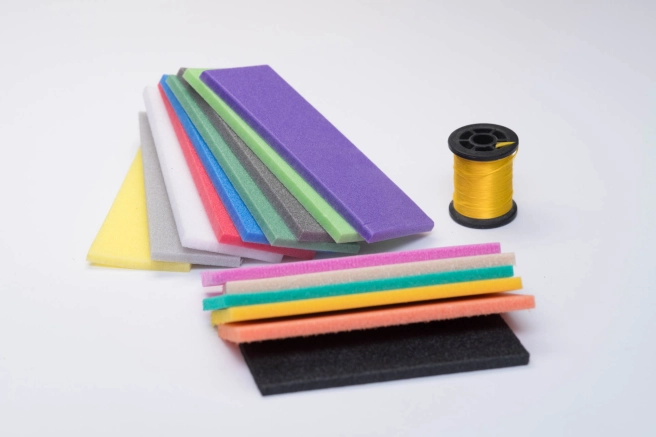
There are basically two kinds of foam: closed cell and open cell.
Closed cell has – as the name implies – closed air cells, and will not absorb water, but only get wet on the outside. Even when you cut it, the exposed surfaces will be essentially waterproof, and that will make the foam float.
As you might already have guessed, the open cell foam is the opposite: it’s like a sponge and will absorb water exactly like a sponge.
Closed cell foam is very commonly used in flies, even those that are supposed to sink, while the open cell type is rarely required in fly patterns.
Another important aspect of the foam is its hardness. How hard or soft the foam is depends on two factors: the material and its density.
Some foam types are hard from the outset, like Styrofoam, while others are soft, which could be Evazote or Plastazote, cross linked and other types. You are probably also familiar with neoprene - as we know it from waders - which is also closed cell and quite soft.
You can also imagine that the size of the bubbles or cells in the foam has an influence on its softness, and even though there might be no direct relation between bubble size and softness, foam made from the same material of course changes character depending on its “fineness”.
I will not cover this in more depth here, but just note that Evazote and neoprene and cross linked (AKA Cross-Linked Polyethylene Foam or XLPE) are pretty common, the former being softer and more stretchy than the last XPLE-types.
All are very fine celled and useful for fly tying, and will be what you normally find in fly shops and hobby/craft shops.
Sheets
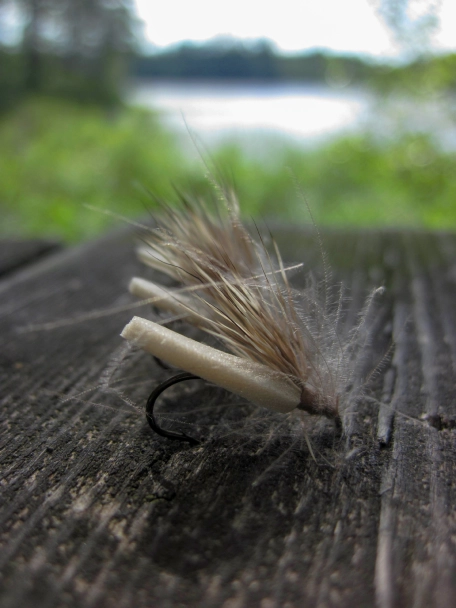
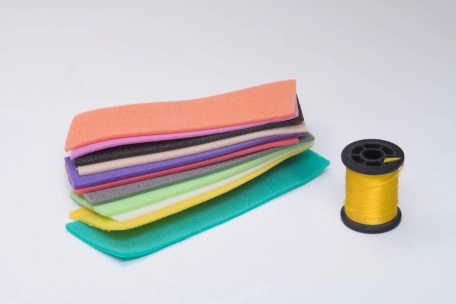
The most common form of foam seen and used in fly tying is sheets.
The foam comes in sheets of varying size and thickness, and can be everything from fairly small pieces about 10*20 centimeters or 4*8 inches to large sheets in A4 and A3 format or even bigger. Since a lot of foam is made for industrial use, it can come in huge sizes and even very large rolls, but of course we rarely see it in this shape for our use.
The thickness varies too, and you can get 0.5-1 millimeter-thin foam (like 1/24th of an inch and thinner), up to almost any thickness that makes sense in fly tying, typically up to 1-2 centimeters or half an inch.
These thicker sheets are almost blocks, and you will also find actual foam blocks. These will enable you to cut three-dimensional shapes rather than just cutting out a flat shape, which is the common way to use thinner foam sheets.
Foam sheets prepared specifically for fly tying are widely available in fly shops both on and offline. Brands like Rainy's, Semperfli and Hareline are common, but you will also find many that are no-name or the shop's own brand.
Craft foam
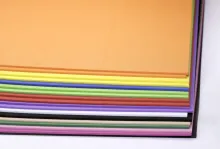
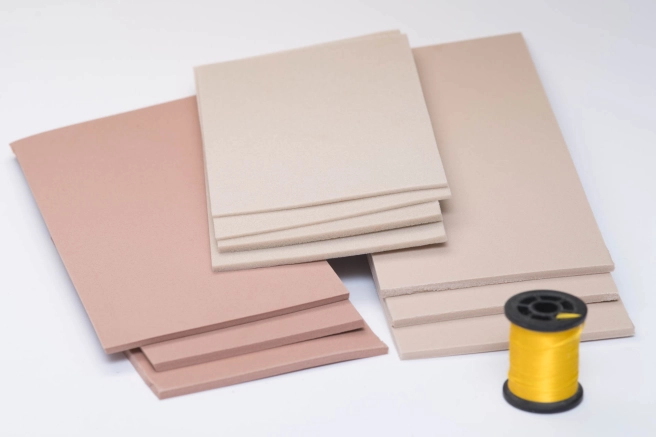
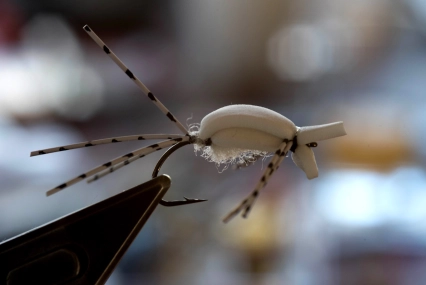
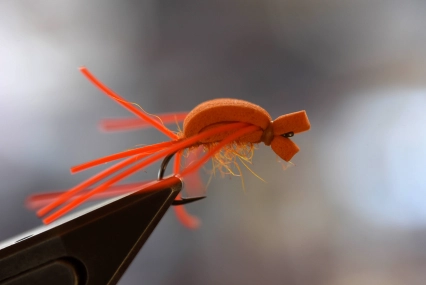
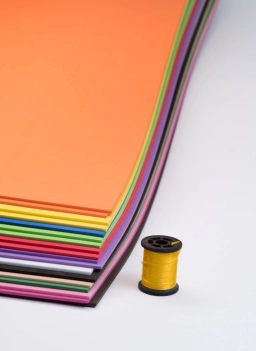
I have been using craft foam to a large extend for many of my foam patterns for ages. Craft foam is usually a little more dense than the foam sold for fly tying, but has the huge advantage of being very inexpensive, and also being easy to find in many shops like craft, hobby and office supply shops.
I have bought mine in physical craft stores as well as online, where you typically get 10 or 20 sheets in up to A3 size for the price of one package of one color of “real” fly tying foam.
Now, I don’t want to take anything away from the material sold for fly tying, because its quality is often better than the craft foam and the available colors are mostly way better suited for fly tying, with a lot of more natural and earthy colors available. Craft foam mostly just comes in bright colors, suited for its purpose, which to a large extent is to please young kids. So finding that special olive or tan color might be a problem, but for white, black, gray, red, yellow, orange and so on, it’s very useful.
So the craft foam can bring you a long way, and with its low price, there’s absolutely no harm done in buying a bunch, and see what it can be used for.
Foamiran
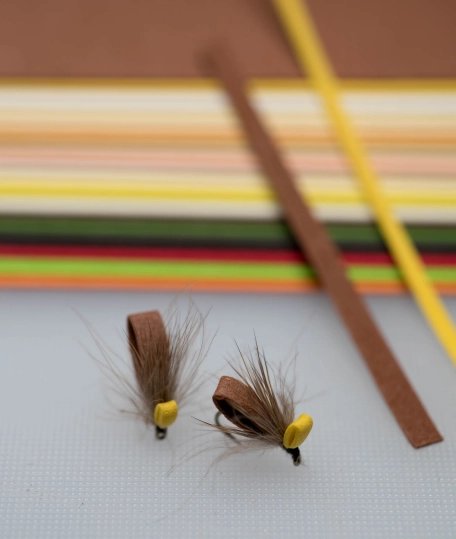
After having published this article, a Dutch reader directed my attention to a type of foam that I didn’t know, and hadn’t covered, and that’s so called Foamiran or flower foam (no, not Oasis, which is something very different!).
This is thin, soft EVA foam, mainly made to make artificial flowers, and because of that available in many ”natural” colors more suited for fly tying than the craft foam mentioned above. I have ordered some and will add my impressions when it arrives. It’s a bit more expensive than craft foam, but available in many more colors. I have only found it in thin sheets (0.8 mm or 1/32 inch), but it’s likely to be available in other thicknesses.
Foam fettuccine
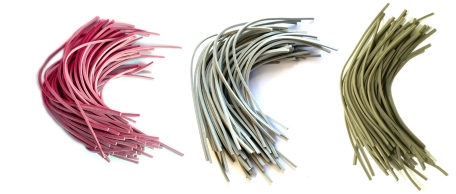
Another useful foam product is called foam fettuccine (branded Chicone's Fettuccine Foam), and is – as the name implies – “foam noodles”, thin strips cut from sheets, all ready to be wrapped as segmented bodies like extended mayfly bodies, or used for saltwater flies like Chicone's Tuscan Bunny and other foam “fur” headed flies.
The fettuccine is available from places like Rainey’s and Hareline dealers. It can be found in many useful colors.
It could also be utilized for small terrestrials like ants and small beetles.
Somewhat along the same lines, but in a slightly different form, you will find Semperfli Foam Combs, which are strips of foam still attached together as a comb. These are cut from 2.5mm thick foam, and available in many colors and in 2, 3 and 5mm widths.
Coated sheet foam
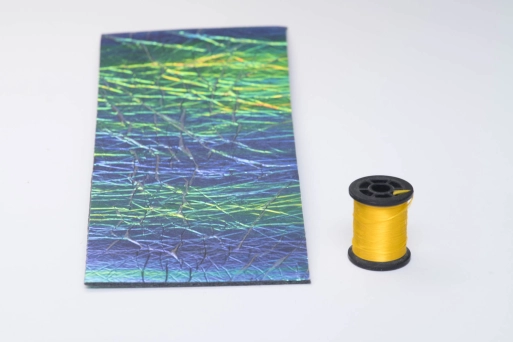
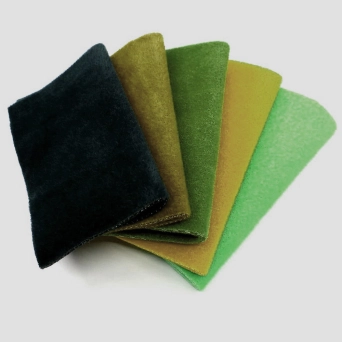
You can get some pretty funky kinds of sheet foam, one type which is coated with a thin layer of a shiny material, making it perfect for beetle imitations with its metallic iridescent surface. This foam is sometimes referred to as Loco Foam or Locofoam .
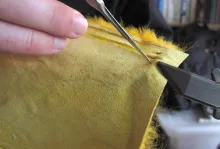
There's also another kind with a fuzzy layer on the outside.
The latter is like a very fine carpet with a foam backside, giving it a very life-like surface, which can be seen used in crab patterns as well as other imitations, which call for a matte, short haired or furry surface.
The shiny, foil covered foam is remarkably like the shell of many metallic beetles, and adding a shell of this foam to a hook makes a surprisingly good beetle imitation – probably more convincing to humans than to fish, since the fish essentially only see a profile from below and rarely see the shiny topside.
The aforementioned craft foam is sometimes also available in a glittery version, where one or both sides has been sprinkled with shiny glitter. I havn't tied with this particular material myself, but again: the price is so low that it might be worth buying for the experiment alone.
Fabrizio Gajardoni
Cords and cylinders
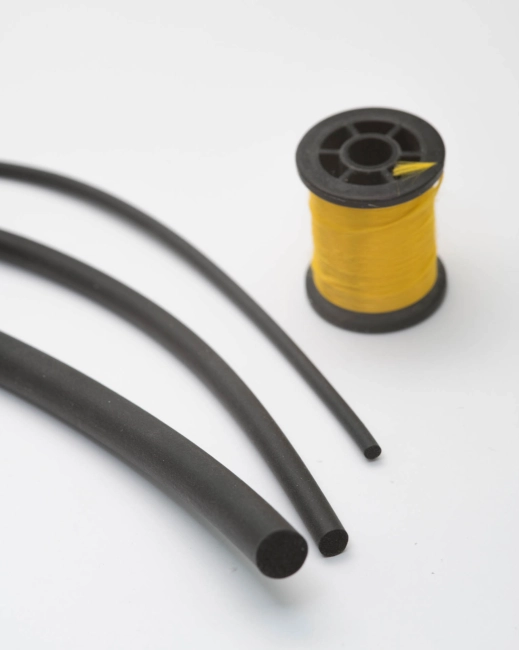
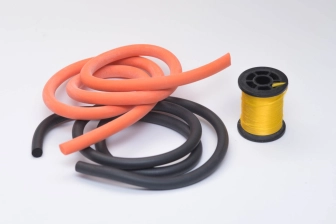
Foam – both the fly-tying kind and other kinds – is also available in cylinders, some so long that they can be called foam cords. These cords can be worth searching for in other places than fly tying shops, because they are widely used in various industries and workshops for gaskets and similar applications. You can look for foam cord, sponge cord and grout filler, which are common alternative names.
And oddly enough (sic!), the cords are way, way cheaper when bought for industry and workshop use, and contrary to many industry products, you can actually buy moderate lengths of it in many places.
These cords can be found in almost any thickness useful for fly tying, from millimeter-thin to up to several centimeters or up towards an inch, and even though black and gray are the most common colors, a bit of searching will probably lead you to a larger variety.
In the fly tying community, you will probably find these products listed as Float Foam.
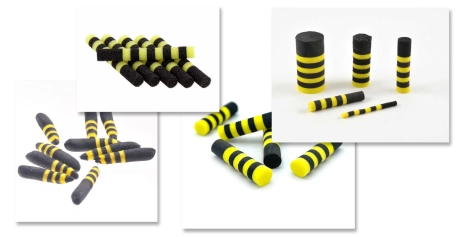
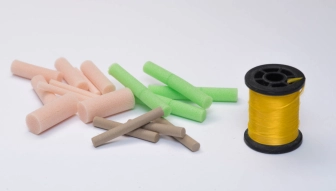
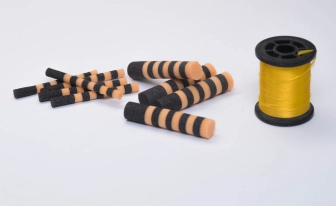
The cylindrical foam can also be found in smaller lengths, which is typically meant to imitate insect bodies. They often come in striped versions, which is essentially sandwiched foam sheets, which have been stamped out in cylinders.
These are very handy for patterns such as wasps and grasshoppers, and can be a great convenience.
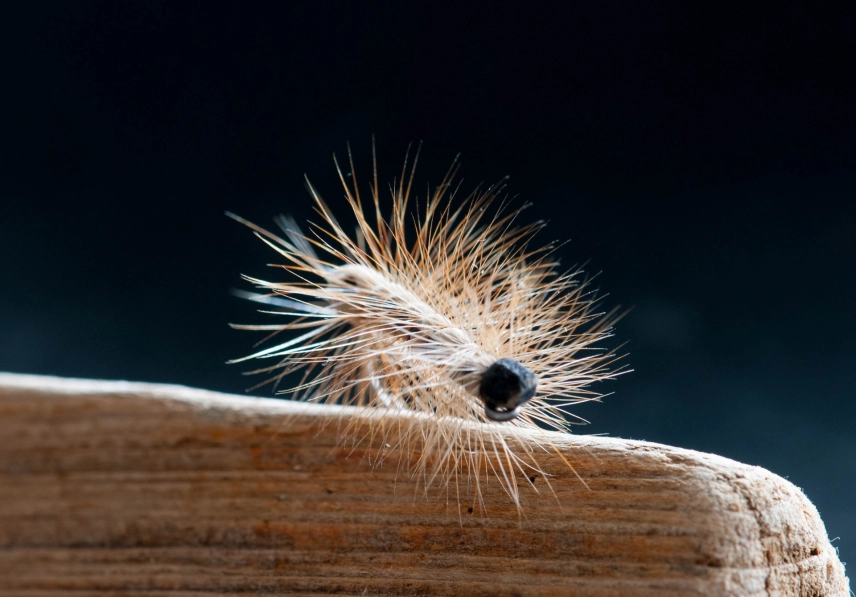
The single color cylinders work well for all kinds of beetles and caterpillars.
Some are just one-diameter cylinders while other types are more realistic in their shape.
Foam bodies and heads
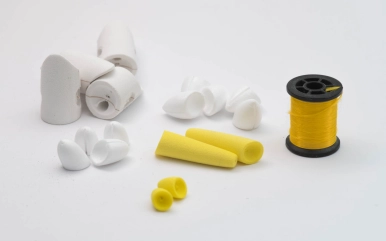
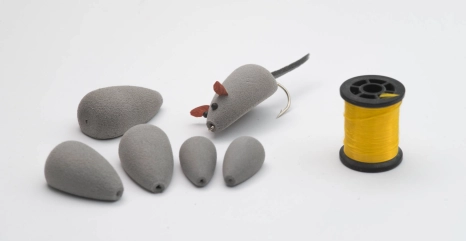
As well as the cylinders, mainly made for insect bodies, you can also get pre-shaped popper heads and bodies made from foam.
The foam quality in these vary from fairly soft, mostly the cross linked type, to very dense and hard, made from hard Styrofoam or similar materials. The latter can be further shaped with sandpaper, drills and files, and can be painted, while the softer ones are usually used as they are.
Many of these have grooves or holes for the hook, and some also have depressions for gluing in eyes.
Foam from the trash
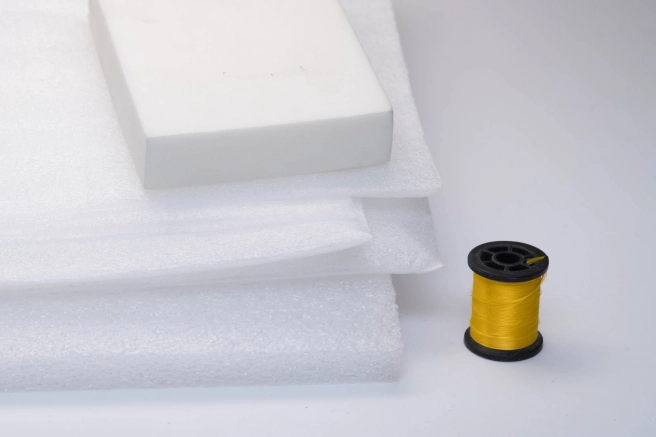
When you get products, which are packaged for protection, it's very often done with foam. Whether it's electronic, glassware, tools or many other products, wrapping in foam is a very common way of securing it from damage.
A lot of this foam is perfectly suited for fly tying!
So the next time you unwrap something surrounded by foam, think to yourself if the foam could be useful for flies. It's mostly white, gray or black and very rarely any other colors, but these shades have their use too, and in some cases you might get away with coloring the white foam with a waterproof marker.
Pre-cut foam and foam cutters
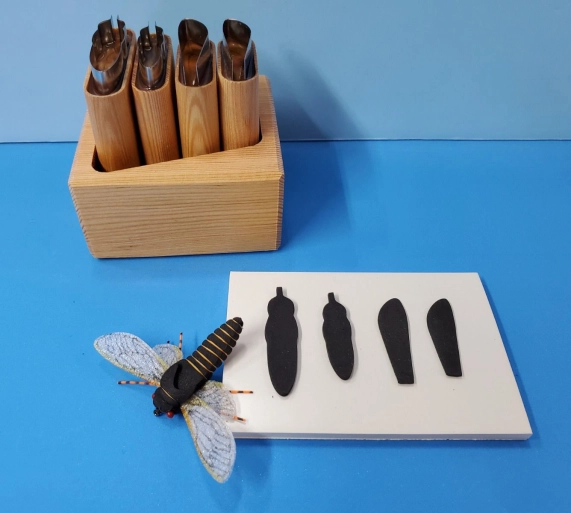
If you want to tie hoppers, beetles or other terrestrials, you will be able to find a surprising number of different pre-cut foam products.
These are stamped out of sheets and packed in bags, and can make it easy to get a good looking and consistent result.
You can find insect bodies like cicada, beetles, dragonflies, hoppers and many more from places like Semperli and Rainy’s.
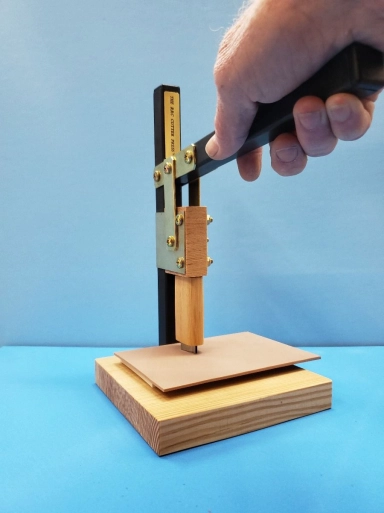
You can also buy foam cutters, which will enable you to make your own pre-cut foam pieces. The most common ones are from US manufacturer River Road Creations, where they make cutters for basically any shape you may fancy. They are quite widely available, but unfortunately a little expensive - but certainly very nice and handy tools. You can get sets with various shapes and sizes for special purposes and pattern types, as well as a small tool/stand, which will help you cut the shapes consistently.
- Log in to post comments