








Better-Winged Olives
A recent tying binge left me with a few thoughts on how to tie a quicker and better blue-winged olive mayfly. The ideas aren't necessarily new, but they certainly are worth sharing.
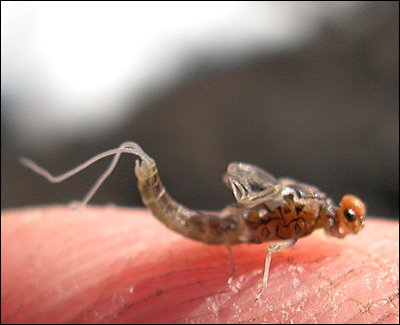
BWO Cripple
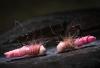
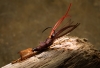
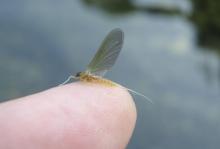
A blue-winged olive cripple mayfly found on the South Platte River in Colorado. Notice the body segmentation and chunky thorax. These are two elements the Better-Winged Olive imitates. Also notice on this severely crippled subject the shortened tail filaments, the underdeveloped wings and forelegs, and the under-developed right eye (the orange left eye is the proper form for this species of mayfly on the South Platte River).
A recent tying binge left me with a few thoughts on how to tie a quicker and better blue-winged olive mayfly for the upcoming BWO season in Colorado. I've always been a fan of A.K. Best's theories on quill-bodied mayflies; they only make perfect sense. Quill-bodied flies provide distinct segmentation in the body (just like the natural) and there is no dry fly dubbing to absorb the water and make the fly sink.
However, I am also a fan of the KISS principle when tying. I loose too many flies to make them each works of art and I don't have time to strip quills and tie on delicate little feathertip wings. So off I went into the deep crevaces of the GFF flytying lab to see what I could do with making a better BWO.
After observing many blue-winged olive mayflies over the course of several seasons worth of hatches across many rivers in Colorado, I collected the following observations for myself (there's nothing new here...):
- BWO's have a chunky thorax that is quite pronounced
- BWO's lay quite low in the water surface
- BWO tails average about a bodies' length, although I have seen some almost 2x long and some as short as 1/2 the body length...let's call 1x-1.5x the average. I tend to tie in 2x lengths and trim to the length required on stream.
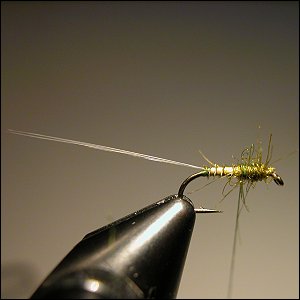
So I took my observations, the typical BWO pattern and some lessons learned from A.K. Best and experimented in the lab. The pattern illustrated below is what resulted... a quick-to-tie and better BWO, in my opinion. But, the fish will be the ultimate judges of that, right?!
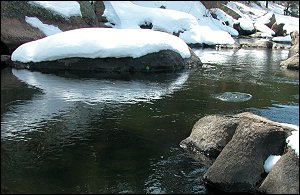
Proof Enough for Me...
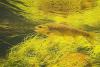
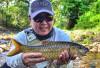
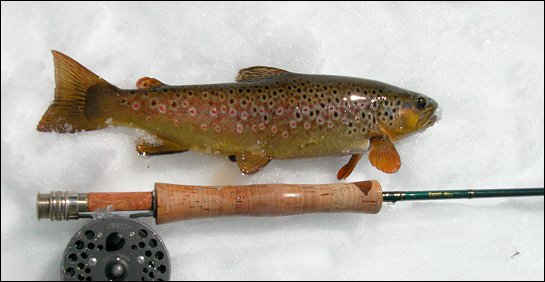
I spotted a rising trout on the South Platte River in Colorado during a recent flyfishing trip (Shown in the picture left). I casted a Better-Winged Olive a few times and got the trout to choose my fly over the naturals. Below is the culprit. Notice the size 20 BWO pattern in the lower right-hand corner.
The Bill of Materials
| The materials for a Better-Winged Olive are simple, using only four, plus tying thread. | |
| Thread & hook | Olive 8/0, size 16 - 22 dry fly hook |
| Tail | 3 or 4 grey or clear micro-fibetts |
| Body | Olive goose biot |
| Thorax | Olive less-absorbent dubbing material such as SLF, beaver or antron. Avoid using camel, rabbit or some other fine, absorbent material. |
| Wings/Legs | Grey (dun) hackle |
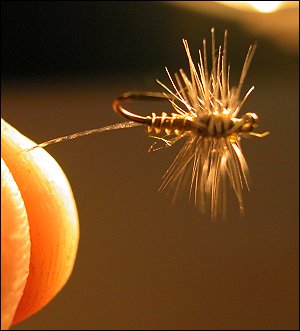
Chunky thorax
Better-Winged Olive attempts to focus on things trout can see by imitating the natural's chunky thorax more closely and put less attention on things above the water surface, such as
wings.
Step 1. |
One secret to making the BWO ride flush in the surface film is to raise the tail just slightly from the plane of the hook shank. Do this by building up a slight thread bump at the tail above the hook barb. It helps to flatten the thread slightly by twirling the bobbin counter-clockwise to undo the natural twist in tying thread.
Read more about thread control in this article by GFF Partner Martin Joergensen. |
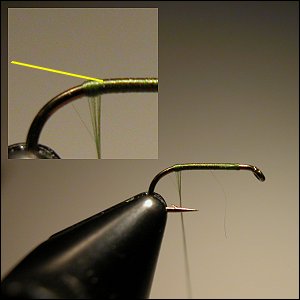 A thread bump above the hook barb helps lift the tailing fibers. The yellow line in the inset photo details how the thread bump can lift the tail fibers. |
Step 2. |
Tie in the micro-fibett tail fibers (3 or 4 will do) and allow the thread bump to elevate the tailing upwards slightly. Try to use only 1 wrap to hold the tail fibers in place. Once they are secure, tie on a goose biot by the pointed end. Be sure to select a goose biot with sufficient length. On size 16 hooks, you'll need the longest ones available to you. Tying Tip: |
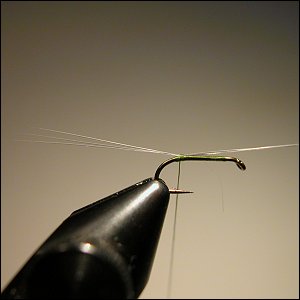 Tie the tailing material on just ahead of the thread bump.
|
Step 3. |
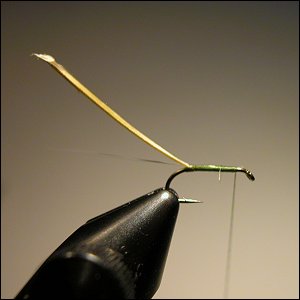
Tie off the biot and move the thread back to the 2/3rd's point on the hook shank as shown in the picture to the right.
Apply enough dubbing to form a chunky thorax being sure not to overdo the dubbing. Remember that you still must wrap a hackle feather over the dubbing. Don't worry about making the dubbing pretty. |
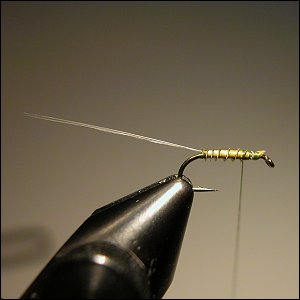 Be sure to evenly space the dark biot edge ridges to get the best segmentation possible.
|
Step 4. |
Strip off a few fibers from the end of the dry fly hackle and tie in the stem across the top of the dubbed thorax. For a size 16, make 4-5 turns of hackle. For a size 18, make 3-4 turns of hackle. For a size 20 and 22, make 2-3 turns of hackle. Tying Tip: |
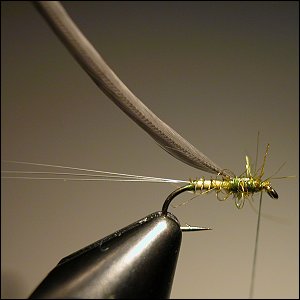 A dubbed body makes hackling more durable by allowing the hackle stem to seat more firmly in the dubbing. A dubbed body makes hackling more durable by allowing the hackle stem to seat more firmly in the dubbing.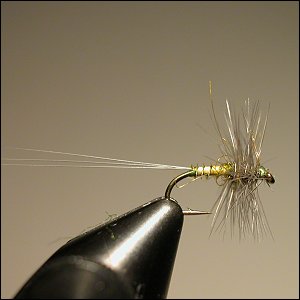 We aren't done yet! This nearly finished dry fly will ride too high on the water. See the next step. |
Step 5. |
Making a BWO ride low on the water's surface is key to imitating a natural more closely. Trim the bottom of the hackle fibers at a slight angle backwards towards the tail, just above the hook point. It is not wrong to also trim the fibers off even with the hook point. Need help with tying off? Read how to tie a whip-finish here. |
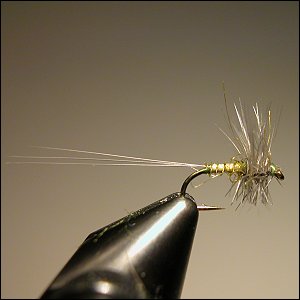 A finished Better-Winged Olive rides low on the water's surface. |
| Eric Peper recently wrote me an email, adding his secret for making Better-Winged Olives: "Enjoyed the article on your BWO pattern, particularly because the design is very close to a design I worked out for BWOs and PMDs a year or so ago -- with one exception. I add a sparse post wing of medium dun Zelon right at the tie-in point of the thorax, and I palmer the dun hackle over the thorax with a couple of wraps on either side of the wing. Reason was that I "see" a shiny wing on most natural duns and the sparse bubnch of Zelon mimics it well." 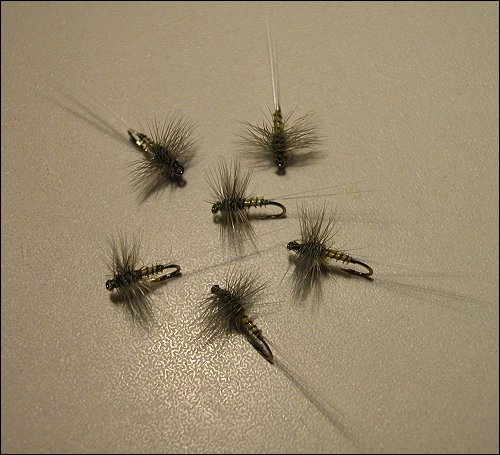 A batch of Better-Winged Olives shows the body segmentation and heavy thorax areas. |
||
Read more about why you should register.



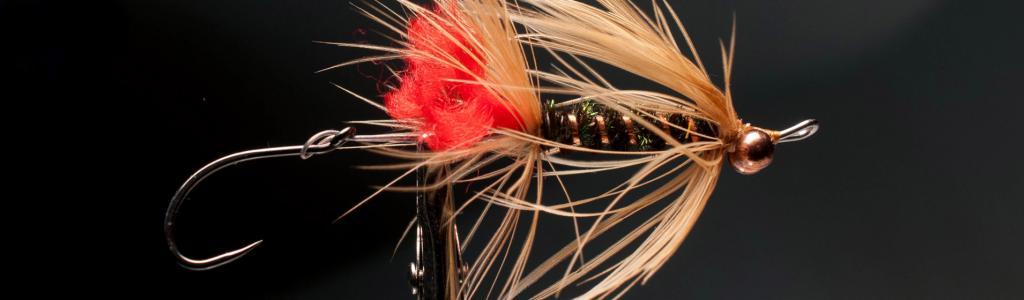
More content from the front page


Since you got this far …
The GFF money box
… I have a small favor to ask.
Long story short
Support the Global FlyFisher through several different channels, including PayPal.
Long story longer
The Global FlyFisher has been online since the mid-90's and has been free to access for everybody since day one – and will stay free for as long as I run it.
But that doesn't mean that it's free to run.
It costs money to drive a large site like this.
See more details about what you can do to help in this blog post.

Comments
You can only give co
You can only give comment when you have fishing with. I am fishing for times with this pattern and in differend waters.
Its a very good fishing pattern!
Just a comment on th
Just a comment on the extremely helpful info shared by all of you. Fly fisher people..and tiers...tend to be great folks. Thanks to all
Nice design. Why no
Nice design. Why not pull a wing case over the hackle to create another variation?
Cello, It's fibbe
Cello,
It's fibbets with an f, and they are synthetic "hairs" - thin and stiff. And, yes, hackle fibers can replace them in many cases. Hackle is not as stiff and straight, but will do fine on most patterns that call for micro fibbets.
Martin
I'm getting back int
I'm getting back into tying after a lengthy absence. What are micro bibetts and will hackel fibers do in their place.
Bruce, A quick se
Bruce,
A quick search for micro-fibettes shows several sources, like
Here at Angler's Den...
...or here at TCO Fly Shop...
...or here at Lakeland Fly-Tying...
...and many other places.
Martin
HELLO: Is there a s
HELLO: Is there a substitute for "grey or clear micro-fibettes". AND, where can 'micro-fibettes' be purchased? Thanks
Steve, every once in
Steve, every once in blue moon someone designs a winner; this is one for the history books and has led me to designing 'profile', flies not too dissimilar to yours and equally successful. Congratulations.
I'm from the U.K. Ou
I'm from the U.K. Our trout are maybe not as big but they are intelligent and it takes a good fly to catch them.
I use size 12 or 14 microbarb hooks. The body I use is 2 fold, one of olive and one of grey. An olive body with a twist of copper works well. Tail of blue dun or pheasant for the nymph. Hackle of pheasant tied nymph style or blue dun (greyish) for the BWO. Thread of olive or black. Our trout love them all year round.
Hi folks....great co
Hi folks....great comments and questions! Allow me to respond to a few...
LONG TAILS: I tie them with longer tails because the BWO's out here in Colorado tend to have longer tails, at least on the water I fish. There's nothing preventing you from tying them longer and trimming them to size when you are on stream.
PMD vs BWO: The difference between a PMD and this BWO pattern is how it sits on the water. Both patterns can easily imitate any mayfly if the colors and size are right. This BWO pattern sits just slightly canted above the water surface while a PMD pattern typically rides right on the surface. I think for all intents & purposes, either pattern will work well for BWO's, if tied in BWO colors.
Thanks to all who have commented!
steve.
Excellent pattern an
Excellent pattern and photos! I modify this silghtly on the really small 22's with less hackle and the addition of Cul de Canard for a main wing to keep it floating in rough water. Many Thanks!
I am a rookie at fly
I am a rookie at fly tying but I must say that I am having a hard time seeing the difference between bwo and pmd. The bodies are both green. what am I missing?
When i tie my BWO's
When i tie my BWO's I use a shorter tail with moose. I was wondering why you use such a long tail?
I stumbled upon this
I stumbled upon this well trying to find new styles for this amazing little bug, boy this pattern is great.
It's snowing here in Michigan, but I can already see a brown suck this little guy down.
Thanks alot
Hello, Very interes
Hello,
Very interesting tying and pattern of the BWO, I stumbled over this page looking for BWO patterns to tie for my trip to the provo river in Utah next April. If you could further help with American style patterns and fly sizes I would be very gratefull.
Kindest regards, Brian Jones, gwynedd North Wales.
Try a nymph out the
Try a nymph out the same way, create the tail out of moose mane
Thank You very much
Thank You very much for shareing this with me. Its the best Blue Wing i have ever seen!!! the photos are first class and enjoyed them very much. God Bless.
Pics missing
Great pattern, but the pics seems to be missing. Please make them visible again
Cheers,
Maukka
No problems here
Maukka,
I have tried looking at the article in several browsers and different gadgets, and all the pictures are there in all cases, so I can't do much to better your situation, I'm afraid.
Martin