









Burning Man
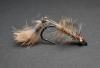
This strange popper came out of Martin Joergensen's vice recently and has already proved its value several times. See why it might be interesting to you, how to tie it (in meticulous details) as well as how it moves - and in video too! And learn why it's called Burning Man.

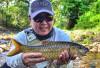
Garfish just love it
|

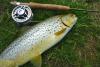
This trout took it
|

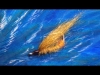
It creeps, it crawls!
|

Ready to swim
|
Not so long ago I was fooling around with foam - again. I have a fascination with this material. Some might call it an obsession. My friends just call it crazy.
Nevertheless I was fooling around.
We had talked about catching sea trout in the surface using a Danish pattern called The Cigar - a huge, cylindrical muddler - and I wanted to try and create something that was a little easier to tie, lighter and easier to cast and still able to make a lot of commotion in the water. I have tied tonnes of muddlers over the years, and deer hair has a huge place in my heart. But foam also has a rightful place in there. Foam is practical, easy to use and cheap. And it makes a lot less of a mess than deer hair.
Minuscule Plipper
A couple of years ago I tied a small Plipper-like pattern for garfish. The Plipper is a pike fly tied on a tube, while the garfish one was tied with narrow strips of yellow foam on small, light saltwater hooks. I never had great success with the fly, and forgot about it until recently.
When the talk fell on surface flies for sea trout I remembered my small, yellow flies. I grabbed some thin tube that the King of the Tubes, Bob Kenly, had once sent me, and cut off a bit. I had some orange closed cell polycelon foam laying around, and just acquired some really bright orange rubber legs and tying thread to match for another project. So the scene was set.

Burning Man
A little background:
I remember reading this article in the US magazine Wired some years ago. It was about a strange festival that drew thousands of people into the desert in Nevada, Arizona or some other remote and arid place in the US. [It's in Black Rock Desert, Nevada]
A couple things struck me about this festival: a lot of naked or at least scantly (and strangely) clad people were obviously having a lot of fun. Means of transportation and places to stay were experimental - to say the least, and the festival would end in a semi-pagan ritual where a huge figure of a man was torched and burnt down. Hence the name of the event: The Burning Man Festival. As you can see from all the images of my fly and the two images below, there is a resemblance. Hence the name of the fly.
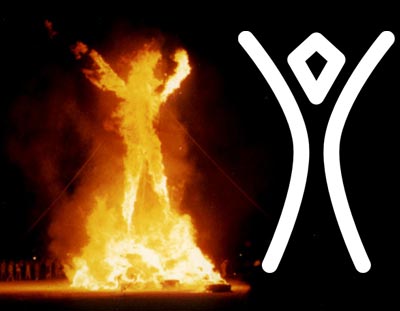
I lifted the above image by Aaron Logan from Wikipedia, which has lots of information on the festival. The symbol to the right is the official Burning Man logo.
Tube tying
Tying on tubes has always fascinated me. Tube flies are practical and different, and the tube technique opens a world to something else. Tube tying also requires a special tool: a tube vice or a tube holder for your vice. I have a large number of these, but recently the two Danes Peter Falkenberg and Karsten Marcher sent some samples of their excellent tube tools. I will return to these later, but just say that they do a great job.
Armed with a short needle in one of the holders I could fix the tube and start my project.
After a few tests I was on to something. Foam and rubber legs combined into something that I liked the look of, and which I thought could do the job. I tied four flies and on my next trip I armed myself with some needle sharp carp hooks and these four flies.
Popping action
That day in early June we were fishing in daylight over a nice stony reef with lots of current. I had started my tests of the fly in still water, but once in the current it showed its virtues.
Popping this little baby across the current drew a lot of fish-attention. Mostly garfish, I'm sure, but I'll bet you that a trout or two also traced the splashes and streaks made by the fly in the surface. My good friend Henning was equipped with one too, and both of us had a lot of fun.
I hooked one sea trout that took violently in the surface and we both got many garfish and missed ten times that.
The fly had passed its test.

Swimming action in a video.
More fish
Just a few days ago we had a couple of trips again, where the fly did what it could to draw up fish. I had a couple of really fierce strikes from large rainbows, and again the garfish were crazy about the fly.

Any color - as long as it's black
|
I'm sure this fly will become a producer in my box - or rather: bag. I keep the flies in a small ziplock bag with a few hooks. Until now I have only used it in the most unlikely situations for the most unlikely fish - brightly lit daytime fishing for sea run trout. These fish are not known to go to the surface during the day. Nighttime, yes, but during the day it's supposed to be wet flies where I fish.
Not any more!
I'm casting a Burning Man first to these fish now. Seeing them come up to chase the fly in the surface is just too exiting to miss.
And of course there are other species that can be attracted to this type of fly too. Mainly bass, but also panfish, different saltwater species, perch and many others. I have also promised myself to break the sacred rituals of salmon fishing with feathers and fur only and hitch this fly across a salmon pool as soon as I get the chance.
And reversing the Plipper->Burning Man process, a Giant Burning Man would definitely be able to attract a pike.

Cutting off tube
|
Tying steps

Tube on the tube holder
|

Cover the tube
|
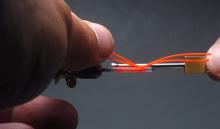
Tie in front rubber legs
|

Cover the legs
|

Cut a strip of foam
|

Punch a hole
|

Pull the foam over the tube
|

Pull back
|

Free the legs
|

Ready to fold
|

Fold
|

Tie it down
|

Trim the upper lip
|

Front done
|

Pull forward
|

Ready for second tie down
|

Tie down
|

Whip finish
|

Cut!
|

Tie the knot
|

Repeat for rear legs
|

Trim the legs
|

Viola!
|

TOBMFP anyone?
|

Notes on materials

The materials
|

Mounting the hook
|
Make sure you get the closed cell foam and use a sheet which is not too thick compared to the size of fly you tie. The tube should be fairly thin, and thinner than the normal tube fly tubes available.
Look for foam at Rainy's and tubes at The Canadian Tube Fly Company or The Fly Fishing Shop. The hooks I use are Kamasan specimen hooks called B983, which are usually available in tackle shops with a wide assortment of gear. Any single, straight eye hook with a sufficiently small eye can be used.
When tying on the fly, pass the tippet through the front of the tube (the end with double foam lips) and tie on the hook with the tube loosly sliding on the tippet/leader. After having trimmed the tag, pull the hook eye a bit into the tube to secure it. Once the fish strikes, the hook will often dislodge from the fly and let the fly slide back up the leader. This keeps the tube from acting as a lever while you fight the fish.
Keep the wet flies and the hooks stored separately to avoid rusty hooks.
Read more about why you should register.
Related content



More content from the front page





Since you got this far …
The GFF money box
… I have a small favor to ask.
Long story short
Support the Global FlyFisher through several different channels, including PayPal.
Long story longer
The Global FlyFisher has been online since the mid-90's and has been free to access for everybody since day one – and will stay free for as long as I run it.
But that doesn't mean that it's free to run.
It costs money to drive a large site like this.
See more details about what you can do to help in this blog post.

Comments
Good too for fall ko
Good too for fall kodiak dollies in fresh water.
Terry, Oops! A sm
Terry,
Oops! A small errror. It's fixed now. Thanks for the heads up.
Martin
pictures are missing
pictures are missing on burning man article
Why would you need a
Why would you need an eye for the hook if you have the space to make a knot for a straight hook?and like that it will fit easier in the tube,and you can use a lot more hooks;thank you for the fly,I think it's an excellent fly.
Stephen, The need
Stephen,
The needle has been mentioned several places on this site, but holding tubes can be a little more complex than just a needle as this recent in-depth tube tool article shows.
- Martin
You don't need a tub
You don't need a tube holder a large sack needle is cheaper and more effective as the tube will jam up on the eye and will not rotate.
I am like Doug, wher
I am like Doug, where would I get a tube holder? I really liked the video.
I need a tube holder
I need a tube holder for my fly vise, any suggestions where I can get one!! Thanks Doug
It's so funny but ta
It's so funny but taking trips up the hwy 395 along the Eastern Sierra to attend the Burning Man festival is what got me back into flyfishing! Fun fly, great name.
Cheers,
Bernard
Looks (again) like a
Looks (again) like a very catchy fly. The video is a nice addition. I'll try to fix a small bunch of marabou underneath. Like a skirt. Thanks for the pattern! I'll try it for asp.
The article is great
The article is great and shows that the "correct behaviour" seldom is how the fish really behave.
The movie is great and it adds a new dimension to the gff, now there is words, pictures, podcasts and movies to educate and entertain readers.
Great work!
Bob, Well you sur
Bob,
Well you sure are in the royalty regarding tube flies, and in my opinion you have broken the barrier several times with your stuff. Need I mention one of the first patterns ever contributed to this site or your entry in our fly tying contest back when?
Martin
"The King of Tube Fl
"The King of Tube Flies" it seems my stock has risen lately, only took me 71 years. Sheesh!!!! I wonder what me next trick will be *LOL*
Whoa, I'm especia
Whoa,
I'm especially impressed by the video!
It's the best I've seen for a long time and watched it again and again.
At least I showed it to my daughter and it helps her to improve her swimming skills, too.
Thanks Martin and I hope there's another GFF-summit this year!
Kai
foam poppers
The Burning Man looks a little like Jack Plott's Hula Popper as shown on this site.
Independent
Pjevsemand,
Yes, there is some resemblance, but the two flies came to life far apart and very separately. The Burning Man owes everything to my own fly The Plipper as told in the text, and wasn't actually inspired by anything else.
Martin