






Jump!
Getting a picture of a jumping fish is not as easy as you may think. You need preparation, skill, timing the right gear and some luck too. Read more about catching fish in the air in this latest article on better fishing photos.

Tarpon jump
|

There but unsharp
|
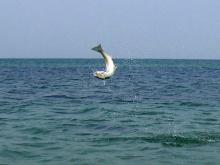
I remember being on a trip for tarpon in Mexico. We caught quite a few babies, and I decided to get some pictures of jumping tarpon.
When it comes to jumping, tarpon are like clockwork: you can rest almost 100% assured that they will jump at least one time and frequently several times as soon as they are hooked. A skilled tarpon angler is also able to tell you when a fish is about to jump, which is usually detectable through the way the fish moves and how you feel that in the line.
Armed with a telephoto lens and a SLR-camera capable of shooting 4-5 pictures a second I thought it would be a piece of cake to get as many tarpon in the air as I wanted.
Not so!
I actually wound up with dozens of images of holes in the water, another dozen nice splashes and yet another dozen or two, which were shaken, blurred or just out of focus.
No, getting fish in the air is not easy. Not at all.
Taking action pictures as a whole is a craft in itself. There is a reason why sports-photographers carry a lot of gear, need a lot of practice and take a lot of pictures to get the crucial moments of a sports event on a picture. It requires planning, skill, timing, the right gear and a bit of luck too.

Another classic
|

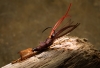
Not a jump
|
Let's break those items down here.
Planning
means putting yourself in the situation where action will potentially take place. Since action is not endless on a fishing trip, there's no meaning in just standing around waiting hours on end for things to happen on the first and the best trip. Take advantage of days, places and periods where the chance of something happening is increased. Like placing yourself next to the guy who catches most fish rather than the one who never catches anything. Or joining a trip for trout, which are likely to run and jump, rather than bream, which will buck and go deep.

Garfish are easy
|
Skill
is of course being able to get the best from the situation. Routine is a key factor here. The more pictures you take, the more you challenge yourself, the better a photographer you will become. Being in the right place with the light right, no shadows or obstacles is one thing that comes with routine. Getting every picture sharp and properly exposed is also something, which is more likely to happen to the skilled photographer rather than the beginner.
Timing
is just a question of pointing, focusing and pressing the shutter release in the right moment.
Just... hah!
The fraction of a second where something happens is there and gone... in a fraction of a second.
Unless you have the scene framed, the object in focus and press that button right there, you won't get what you're seeking. Cameras have shutter lag, buffer problems, slow autofocus and much more, and learning the ways of your camera is one way to get closer to that elusive fraction of a second. Of course a series of shots will increase your chances, and firering 8-10 shots in a couple of seconds can usually ensure one or two capturing the right fraction of a second.
The right gear
is not necessarily the greatest and fastest camera of the bunch. I have shot many good action pictures with my trusty compact camera, but at the same time I have to admit that my superfast SLR's with momentary response, fast autofocus and 4-5 images per second do increase my chances. But those beasts have also taken plenty blurred pictures of empty space and holes in the water.

The original
|
Close crop
|

Horizontal
|

Vertical
|

Different perspective
|
Luck
is what produces a lot of good images, and also action pictures. Don't count on luck and rest assured that lots of practise will increase you luck substantially!
A last piece of advice is simply to shoot a lot of pictures. Keep the shutter down and let the camera run wild as long as there's a chance of the fish running, jumping or just shaking its head in the surface. Since we're talking digital pictures the film and development is no issue, and you definitely get more good pictures the more you shoot. It's simple statistics.
With all that in place there's still a narrow chance of getting that perfect picture of a fish out of the water with water splashing and drops flying.

Curly jump
|

Plosh!
|
Provoking a jump
You can actually provoke a fish to jump. This is not something that you should do as a routine since it probably puts even more stress on the fish than is already the case when you are fighting it. But never the less it's possible to entice many fish into some arial acrobatics.The key is pressure, and often sideways pressure.
If you lower your rod as the fish is swimming away from you and press the tip hard against the direction, which the fish is swimming, you will often see that the fish will swim harder against the pressure. And in many cases it will gain speed, and in a few of these cases exit the water. This goes for fish, which are willing jumpers, such as tarpon, certain other salt water species and trout -- rainbows in particluar.
As an angler you can often detect the jump through the line, which will move quickly through the water. This gives you a chance for forewarn the photographer, who can aim beforehand and get off a series of shots from before the fish exits the water.
Fish are also much more willing to jump in the beginning of a fight, and most of the above mentioned species will start off with a jump or two as soon as they are hooked, so be ready.
- Shooting the sun
- Shadows
- Reflections
- Fly pictures
- Close to the surface
- Shoot the weather
- Pictures of nature
- Gear pictures
- Bent Rods
- Waterscapes
- Clear Water
- Casting pictures
- Macro
- Jump!
- Compose
- Underexpose
- Use a tripod
- Glorious light
- Fishy pictures
- Bring it!
- Perfect Camera
- Use a fill flash
- Go low
- Go close
- Heads
- Fins
- Tails
Read more about why you should register.
Related content




More content from the front page


Since you got this far …
The GFF money box
… I have a small favor to ask.
Long story short
Support the Global FlyFisher through several different channels, including PayPal.
Long story longer
The Global FlyFisher has been online since the mid-90's and has been free to access for everybody since day one – and will stay free for as long as I run it.
But that doesn't mean that it's free to run.
It costs money to drive a large site like this.
See more details about what you can do to help in this blog post.

Comments
I shoot fishing prof
I shoot fishing professionally as a staff photog for a major fishing media company. My signature shot is jumping fish. I can tell you that the most Important factors in getting a quality fish jump shot are : 1) focus. 2) shutter speed. you can point your camera where the fish is most likely to jump. So you better be shooting 1/1600 or faster. Then you need to nail your focus. 3) have a long enough lens where you do not have to crop too heavily. Shoot on bright days. You will get better pics. Don't rely on luck. Practice focusing on birds. They are easier to shoot than jumping fish, but they will help you hone your shooting skills.